‘Decontaminated’ Fukushima soil delivered to Japanese PM’s office
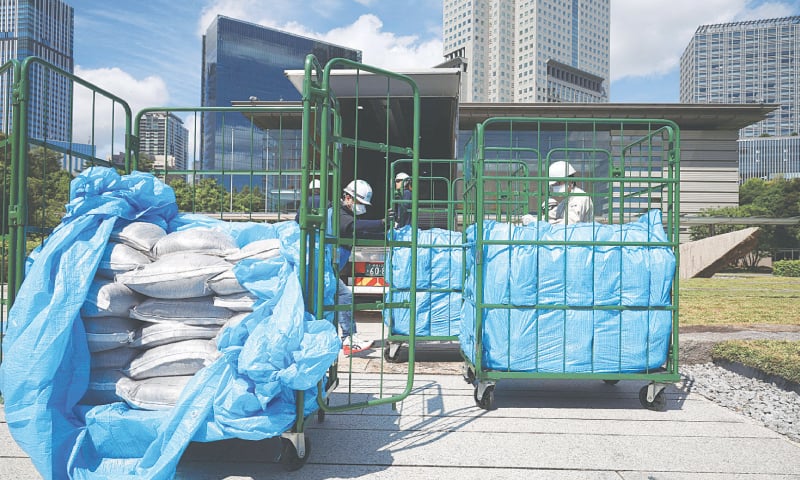

TOKYO: Dozens of bags of mildly radioactive soil collected from near the stricken Fukushima nuclear plant were delivered on Saturday to the Japanese prime minister’s office, in an effort to show it is safe for reuse.
Soon after the March 2011 tsunami and nuclear disaster, authorities scraped a layer of contaminated soil from swathes of land in Fukushima to reduce radiation levels.
A vast quantity of soil — 14 million cubic metres — has since been stored at facilities near the Fukushima Daiichi plant, with the government setting a 2045 deadline for its transfer elsewhere in the country.
Most of the stored soil contains low levels of radiation equivalent to or less than one X-ray per year for people who directly stand on or work with it, the environment ministry said. But with few willing to take the contaminated earth, the government took it upon itself to reuse some of the soil to show it is not dangerous.
On Saturday, workers unloaded bags of the dirt from a truck in the front yard of the prime minister’s office in central Tokyo, with earlier reports saying it will be used in flower beds.
A layer of ordinary soil around 20 centimetres (eight inches) deep will sit on top of the Fukushima soil, according to the environment ministry. Opinion polls suggest that Prime Minister Shigeru Ishiba’s coalition could lose its majority in upper house elections on Sunday, a result that might push him to resign after less than a year in office.
Published in Dawn, July 20th, 2025