NJPMC forms body to formulate response on disappearances


 0
0
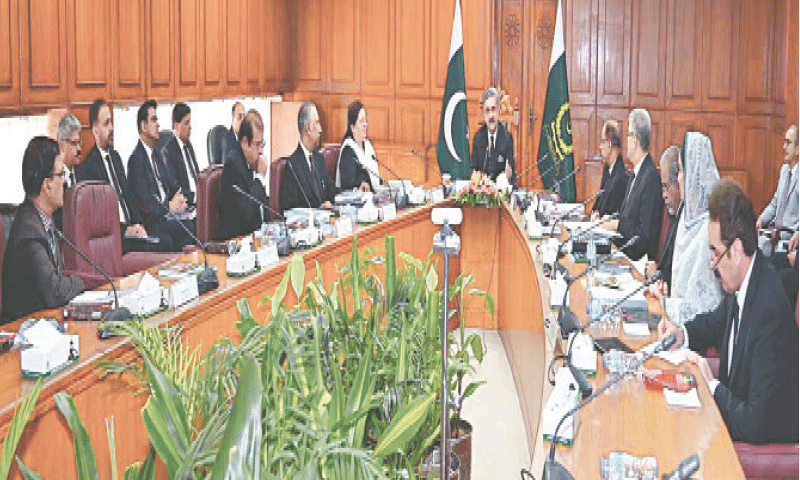

ISLAMABAD: The National Judicial Policy-Making Committee (NJPMC) has taken serious notice of instances of enforced disappearances and unanimously resolved that the judiciary would not compromise on its constitutional duty to safeguard fundamental rights.
Presided over by Chief Justice of Pakistan (CJP) Yahya Afridi, the NJPMC constituted a dedicated committee to formulate an institutional response, after taking into consideration the concerns of the executive, which will be communicated through Attorney General for Pakistan (AGP) Mansoor Usman Awan.
The 53rd meeting of the committee was held at the Supreme Court on Friday, which was attended by the chief justices of all high courts, while the AGP attended on special invitation.
It decided to protect judicial officers from external influence and asked the high courts to establish structured mechanisms for reporting and redressal of instances of enforced appearances within a stipulated timeframe.
Petitions pertaining to tax, financial matters to be heard by division benches
To improve the commercial dispute resolution landscape, NJPMC also approved the establishment of Commercial Litigation Corridor, with specialised courts and benches.
In a step towards strengthening Alternative Dispute Resolution (ADR) mechanisms, the committee approved the launch of a court-annexed mediation regime as a pilot project.
The ethical and policy implications of using generative AI in judicial functions were also discussed and the National Judicial Automation Committee (NJAC) was tasked with finalising a comprehensive charter on ethical use of AI in this regard.
On the request of the AGP, NJPMC decided that all constitutional petitions pertaining to tax and financial matters will be heard and decided by division benches of the high courts instead of single benches.
Published in Dawn, July 12th, 2025