Govt has decided to enhance water storage capacity due to India’s actions: PM Shehbaz


 0
0
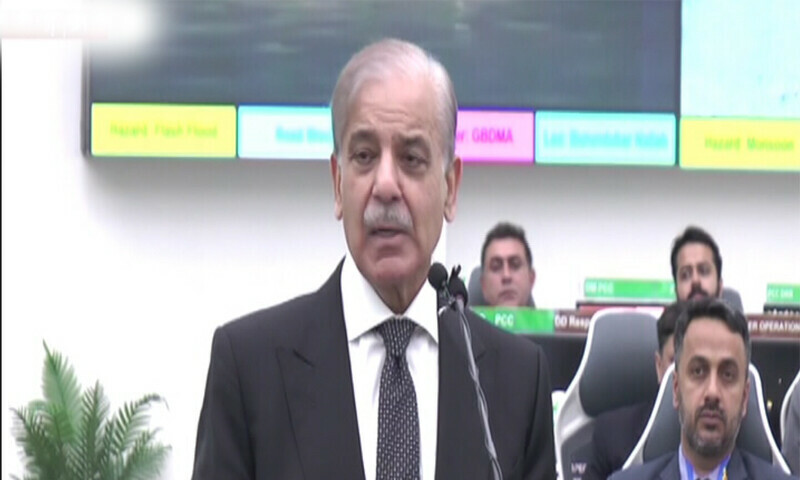

Prime Minister Shehbaz Sharif on Tuesday said that the government has decided to enhance the country’s water storage capacity, given India’s designs to weaponise water.
India in April held the Indus Waters Treaty (IWT) in abeyance following the attack in occupied Kashmir’s Pahalgam that killed 26 — an incident New Delhi blamed on Islamabad without evidence. The treaty allocates the Indus Basin’s six rivers between the two countries: India gets the eastern rivers (Ravi, Beas, Sutlej), while Pakistan receives nearly 80 per cent of the water from the western rivers (Indus, Jhelum, Chenab).
Pakistan termed any attempt to suspend its water share an “act of war”, noting the IWT had no provision for unilateral suspension. It later said it was considering court action, citing a violation of the 1969 Vienna Convention on the Law of Treaties. The Permanent Court of Arbitration (PCA) in Hague also ruled India cannot unilaterally suspend or hold the IWT in abeyance.
During a visit to the National Emergencies Operations Centre today, the prime minister referred to the PCA’s order, emphasising that India had no authority to suspend the IWT unilaterally.
“But the enemy has certain evil designs against Pakistan and wants to take steps against the waters treaty. For that, the government has decided that we will build our water storage.”
He said the government would build a “non-controversial water storage capacity” by utilising resources such as the Diamer Bhasha dam and others.
PM Shehbaz said there was a clear clause in the 1991 water accord between the provinces to build on water capacity.
“We will build this capacity with our own resources in the next few years. There is a critical role of the National Disaster Management Authority in this.”
The prime minister directed that weather warnings and calamity threats should be regularly issued through phone messages in collaboration with the Pakistan Telecommunication Authority.
The prime minister recounted the disastrous impacts of the catastrophic floods in 2022. He said that Pakistan was unfortunately among the countries on the world map which could be hit by natural disasters such as cloudbursts, even though it had hardly any contribution to the greenhouse effect.
During the year 2022, Pakistan had suffered more than any country in the world, he noted. More than 1,700 lives were lost, vast stretches of farmland were washed away, homes and infrastructure were damaged, and the national exchequer suffered losses of Rs30 billion, according to government estimates.
The prime minister further said that glacial melting due to heat waves also demanded the highest level of preparedness.
“What happened in Swat in which precious lives were lost, engulfed the entire nation in a pall of gloom,” he said and stressed that the stakeholders in the matter should take an honest review of the incident, directing for a formulation of a comprehensive mechanism in collaboration with the provinces to prevent such occurrences in the future.
The prime minister also ordered a report in this regard.
He opined that in the aftermath of the floods of 2022, the relevant ministers negotiated the grants and public-private partnerships for building resilient infrastructure in the country.
The prime minister appreciated the National Emergencies Operations Centre and expressed hope that the relevant authorities would fully utilise the resilient platform for the progress of the country’s economy and social sectors.
He also assured the government’s complete support in strengthening the institute and its capacity building.
The prime minister hoped that the facility would be connected with the provinces and could convey real-time information with interventions such as an early warning system.
During his visit, he was given a briefing by NDMA Chairman Lieutenant General Inam Haider Malik over the current monsoon season, the flood situation and the precautionary measures taken in this regard.