Homegrown satellite imagery tool wins top Google prize


 0
0
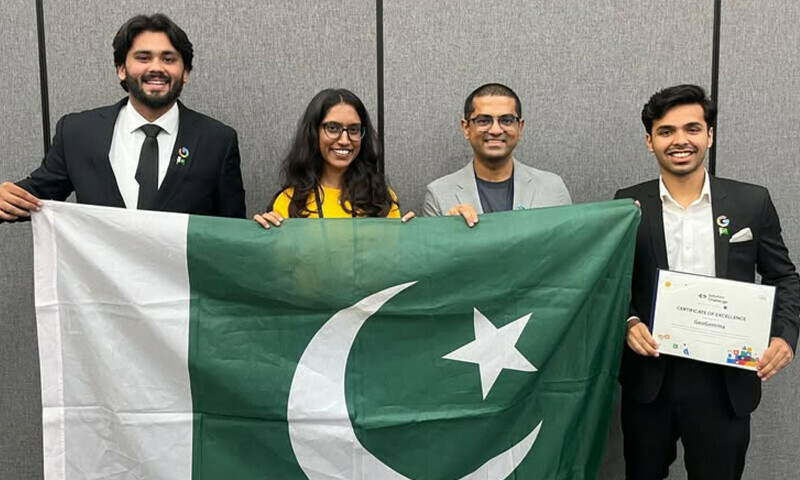

IN 2024, Ahmed Iqbal and Hanzila Bin Younus, who were studying at Islamabad’s Institute of Space Technology, had to submit a final-year project to receive their bachelor’s degree in space sciences.
They had two paths: either treat their project as a mere requirement to earn the degree, or turn it into something that a giant like Google may be interested in.
They opted for the latter path, which led to the development of Geo Gemma — an open-source Large Language Model (LLM) integrated with the Google Earth Engine, to analyse spatial data and satellite imagery without the need for lengthy codes.
Last week, GeoGemma won the ‘Best AI Use Case’ award at the Asia-Pacific (APAC) Solution Challenge, jointly organised by Google and the Asian Development Bank in Manila.
Team from Institute of Space Technology, Islamabad say their innovation can be used across several fields, such as oil and gas, real estate, supply chain etc.
Speaking to Dawn from Manila, Mr Iqbal said GeoGemma was created with the idea of automating geospatial analysis.
“[The] Google Earth Engine hosts updated satellite imagery from the entire planet. There is 80 petabytes of data there, and you can overlay your maps to analyse different geographical variables — from temperature on K2 to thermal imaging,” he explained.
But this engine has its limitations; the user has to have a certain level of programming and coding expertise to retrieve satellite data and analyse it.
GeoGemma intended to change this — make this data accessible to anyone who wants to analyse it by writing just a few prompts detailing what data they need. Mr Iqbal and his team were able to accomplish this with funding from Google.
Around June last year, he came across a research grant opportunity by Gemma Academic Programme, organised by Google DeepMind, a subsidiary of Google’s parent company Alphabet that works on AI development.
Mr Iqbal, Mr Hunzala and their supervisor Dr Sajid Ghaffar formed a GeoAI team and applied for the grant. “[We] pitched our idea of fusing Google Earth Engine with the open-source Gemma model.”
In September 2024, the team got a $10,000 research grant from Google DeepMind.
APAC Solution Challenge
GeoGemma was selected as one of the top 10 projects from a pool of 750 entries from over 200 universities. A team from Fast University — who developed a Gemini-powered document editor for neurodivergent users — was the second team from Pakistan to make it to the top 10.
For the big stage, the team of two needed more resources. They included Abdullah Asif and Khaleelullah, two undergrads studying Computer Science at the IST. Mr Asif joined as the Front-end Web Developer, while Mr Khaleelullah was the tech lead and AI engineer.
Simplifying geospatial analysis
Mr Iqbal said GeoGemma is a simplified spatial analysis tool, which can fetch satellite data by understanding prompts in a natural language.
“We are actually pushing boundaries by building a simple model that can even be loaded on computers without the need of servers,” he said, adding the total size of a model is less than 2GB and it can run on any laptop.
He believes satellite imagery and remote sensing are at the cross-sections of many industries — sustainability, oil and gas, real estate, supply chain, etc.
The team plans to release their software before the end of this year.
“Right now, we have a solid foundation. We have recognition. We have credibility. But moving forward, there is so much potential in terms of industries we can partner with and make custom modules that’d be proprietary tools,” Mr Iqbal said about the future of GeoGemma.
Published in Dawn, June 30th, 2025