0
0

UNITED NATIONS, May 12: Pakistan on Thursday reiterated its support for creating an international counter-terrorism centre as proposed by Saudi Arabia to create a clearer institutional framework to respond urgently to terrorist threats.
Sooner or later, the international community would have to evolve an agreed legally clear definition of terrorism, Pakistan’s Ambassador to the United Nations Munir Akram during informal consultations of the UN General Assembly on the report of the secretary-general regarding ‘Comprehensive counter-terrorism strategy.’
Mr Akram noted: “There are continuing attempts to circumscribe the scope of terrorist actions, by seeking, in particular, to exclude the phenomenon of the reality of state terrorism.”
Reflecting that during the world summit last year, “everyone was prepared to agree that all acts of deliberate violence against innocent civilians and other non-combatants should be condemned and outlawed as terrorism regardless of their motivation or justification offered,” he lamented: “Yet, agreement on a definition escaped us because state military forces were sought to be included in the category of non-combatants.”
He said such inclusion was untenable in at least three circumstances: where a state’s military is in occupation of a territory which is not its own; where states’ forces are engaged in a military campaign to suppress the legitimate and recognised rights of peoples to self-determination and independence; and where a state’s forces are engaged in committing genocide, war crimes or crimes against humanity on their own territory.
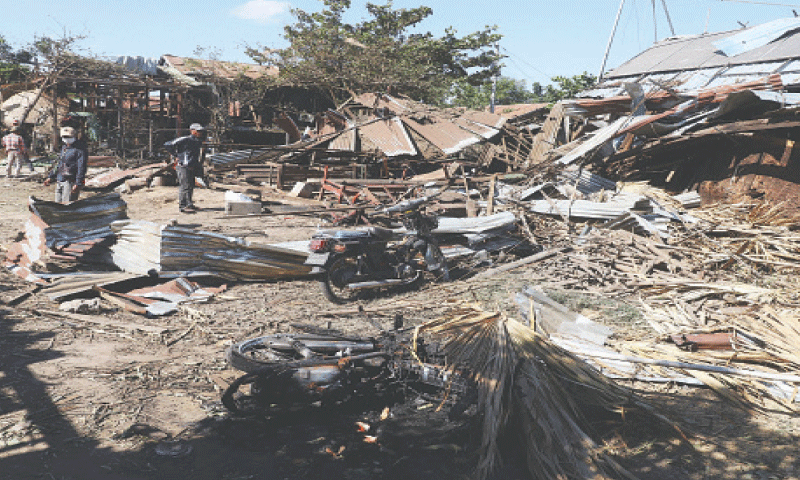
He said militaries of states in situations of foreign occupation often resorted to wanton violence against innocent civilians and other non-combatants, including carpet-bombing or artillery bombardment of cities, towns and villages, collective punishments, summary and arbitrary executions, targeted assassination etc. These were surely acts of terrorism –- state terrorism, he said.
In military campaigns to suppress the rights of people to self-determination and independence, the action of a state’s military are illegal under international law and violent actions against innocent civilians and non-combatants should, therefore, be categorised as terrorism, equally with such violence carried out by non-state actors, he said.
He said the situation where a state’s forces are engaged in genocide, war crimes or crimes against humanity on their own territory was, perhaps, more legally controversial.
The aim of addressing the root causes “is not to justify terrorism but to understand it and thus to overcome it,” he said.