0
0

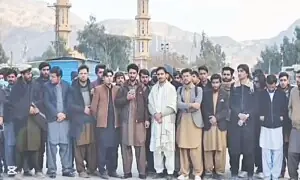
SOUTH WAZIRISTAN: In a significant development in the tribal region, a jirga was held here the other day at Sarpul Ground in Wana, Lower South Waziristan, organised by the Sulemankhel tribe under the patronage of the newly established Pakistan Tribal Movement.
The gathering brought together senior political leaders, tribal elders, religious figures, and representatives from various schools of thought, marking a rare moment of unity across aparty lines in the region.
Presided over by Pakistan Tribal Movement central chairman Haji Gul Mir and vice chairman Ajab Khan Sulemankhel, the jirga attracted a large number of influential personalities, social activists, and community elders.
The event saw strong representation from key political parties, including the Awami National Party (ANP), Jamaat-i-Islami, Pakistan People’s Party (PPP), and Jamiat Ulema-i-Islam-F, reflecting a collective resolve to address the challenges facing tribal communities.
Addressing the participants, Haji Gul Mir thanked all political and social figures for attending the jirga, noting that the progress of the Pashtun nation hinges on unity and mutual cooperation. He stated that the Pakistan Tribal Movement would serve as a broad-based platform committed to securing the constitutional, legal, and democratic rights of tribal people across Pakistan.
Vice chairman Ajab Khan Sulemankhel reiterated that the Pashtun people have always stood by Pakistan and will continue to contribute to its peace and progress. He formally announced the formation of the Pakistan Tribal Movement, describing it as an inclusive socio-political organisation dedicated to representing the aspirations of tribal citizens and mobilising support at the grassroots level.
At the conclusion of the jirga, district-level leaders of various parties voiced their endorsement of the new movement.
ANP’s Ayaz Wazir expressed commitment to regional development, Asadullah of Jamaat-i-Islami vowed to stand by those advocating for tribal rights, Amanullah Wazir of the PPP called for unity in pursuit of peace and political harmony, while JUI-F’s Maulana Sultan emphasised the preservation of religious and tribal values.
The jirga, seen not merely as a political event but as a symbolic act of tribal awakening, underscored a shared vision for justice, dignity, and progress through peaceful and organised efforts. Participants affirmed their commitment to working collectively for the socioeconomic uplift of the region and the constitutional recognition of tribal identity.
Published in Dawn, June 28th, 2025