• Tax on income derived from dividends raised to 29pc
• 20pc tax proposed on profits from investments in government securities
• FED of Rs10 imposed on one day-old chicks
• No changes to voluntary pension regime; tax on pensions won’t apply to commutation & gratuity amounts
ISLAMABAD: As the government announced a modest tax relief for the lower income slabs, Finance Minister Muhammad Aurangzeb on Monday introduced three new tax measures in the National Assembly to offset its revenue impact — part of the country’s ongoing commitment to remain within the fiscal parameters agreed with the International Monetary Fund (IMF).
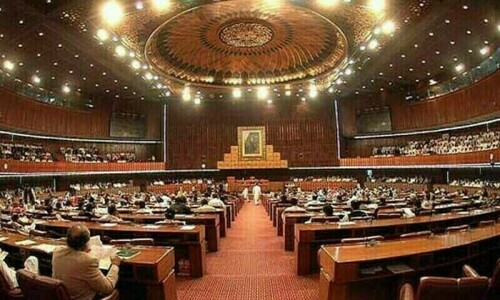
In his winding-up speech, Mr Aurangzeb informed the National Assembly that the proposed measures aim to offset the revenue shortfall resulting from the tax relief, while ensuring that the industrial and commercial sectors are not subjected to additional burden.
As part of three new revenue measures, the government has proposed raising the tax rate on income derived from the debt portion of dividends issued by mutual funds to companies — from 25 per cent to 29pc. The revision aligns this category with the tax rate already applied to other corporate income streams.
A 20pc tax has been proposed on profits earned by corporations and companies through investments in government securities — underscoring the government’s broader objective of expanding credit access for the private sector.
Additionally, a federal excise duty (FED) of Rs10 has been imposed on one-day-old chicks, aimed at ensuring the poultry industry contributes its due share to national revenue.
Mr Aurangzeb stated that the government initially proposed reducing the tax rate from 5pc to 2.5pc for annual incomes between Rs600,000 and Rs1.2 million. However, following the prime minister’s directive, the rate was brought down to 1pc for this income bracket.
He also clarified a misperception stemming from his budget speech, where it was mistakenly inferred that the proposed tax on pensions would also apply to commutation and gratuity amounts. He said that that would not be the case. It was also clarified that there would be no changes in the taxation of voluntary pension scheme.
The minister said that the tax will only apply to individuals receiving annual pensions exceeding Rs10 million, while pensioners above the age of 75 are entirely exempt from any form of taxation.
He also informed the lower house that the Federal Board of Revenue’s (FBR) powers related to tax fraud have been reassessed, in line with proposed amendments in the Finance Bill.
Under the revised framework, tax fraud cases are now classified as either ‘cognisable’ or ‘non-cognisable’. For cases involving alleged tax fraud of up to Rs500m, the FBR will no longer be empowered to make arrests without a court-issued warrant.
Furthermore, any arrest under this provision must meet at least one of the following criteria: the accused has deliberately failed to respond to three official notices; the individual has attempted to evade investigation; or there is evidence of record tampering.
The minister clarified that, even in such instances, arrest authorization will not rest with a single officer, rather must be approved by a three-member high-level committee within the FBR. Any individual taken into custody would have to be presented before a special judge within 24 hours.
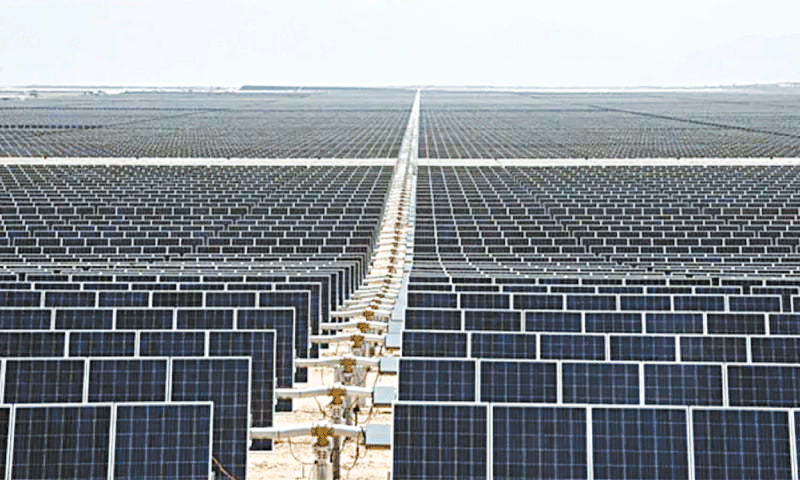
Mr Aurangzeb also informed the National Assembly that the amount of sales tax proposed on solar power equipment had now been reduced to 10pc. However, he said, this tax will apply to only 46pc of imported components, resulting in a modest 4.6pc increase in the overall price of imported solar panels.
The original Finance Bill also proposed curbs on large asset purchases by undocumented individuals.
However, these restrictions will not apply to residential properties valued up to Rs50 million, commercial plots or properties up to Rs100 million, and vehicles priced up to Rs7 million.
Additionally, under existing law, capital gains tax will not be levied on the sale of property held for more than six years, provided the asset was acquired before July 1, 2024.
The minister said that such property will be subjected to 4.5-6pc withholding tax on purchase, which he said was generally reimbursed upon filing returns. To give relief, property that was in personal use for 15 years or more would not be subject to this withholding tax.
The government has proposed levying a sales tax on the import of raw cotton and yarn, in a bid to narrow the price disparity between imported and locally produced goods, while bolstering the domestic agriculture sector.
Published in Dawn, June 24th, 2025