Lights flicker, doors slam, fridges open and toy cars get pushed back and forth by invisible forces in Deemak, the second “legit” horror film to come from Pakistan in the last decade or so (the last one was Siyaah, also labelled as a psychological horror). However, one should point out that the ‘legit’ word comes with a bit of caveat.
Deemak, written by Ayesha Muzaffar and directed by Rafay Rashdi (Thorra Jee Le) is a celebration of a glass half-full. It is a psychological thriller, diluted in a conventional haunted house story that touches — and that too, fleetingly — on some interesting ideas.
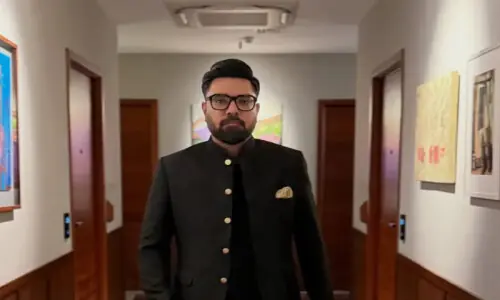
Hiba (Sonya Hussyn, excellent), the young beautiful wife of a construction engineer Faraz (Faysal Quraishi, as perfect an actor as can be), learns that she will always be second fiddle — if not lesser — to her husband’s crotchety mother, Kulsoom (Samina Peerzada), who is relentless and consistent in her bad-tempered, verbal and emotional abuse of the young bride.
For the first quarter of the film — which leads well into the birth and pre-teenyears of her two children — Hiba, subservient and accommodating, is lashed at with words from Kulsoom that are doubled down with fuming ire by Faraz, who is perpetually blinded by his mother’s love.
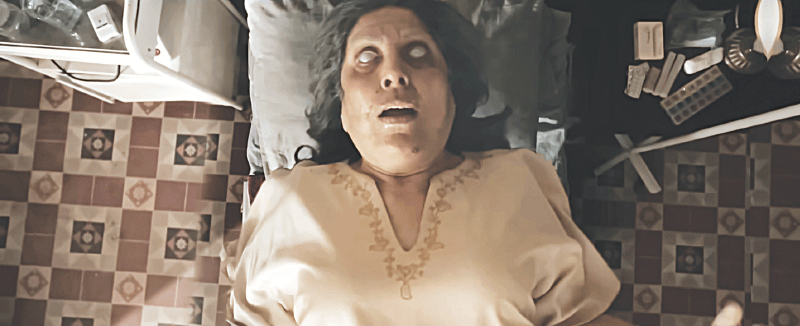
Faraz’s exasperated outrages intensify at Hiba and the children, especially after his mother slips on the stairs, falling right into a coma; the older woman, now bedridden, recovers just enough to scare her home nurse after being possessed by a djinn.
Deemak has some interesting ideas that never reach proper resolution. But it still one of the better productions from Pakistani cinema
With little love, and nearly no remorse (one scene shows us that Faraz is a genuinely good man), one wonders why Hiba chooses to stay with this family — or in hindsight, why a horror film chooses to take the path of a routine Pakistani television drama about bad mother-in-laws and good, brow-beaten, tongue-lashed and emotionally abused wives.
In between these scoldings, the “deemak” (termites) — a visual cue to how abuse can eat away at one’s psyche — slowly creep their way high up the walls, designing intricate abstract trails that only the children notice.
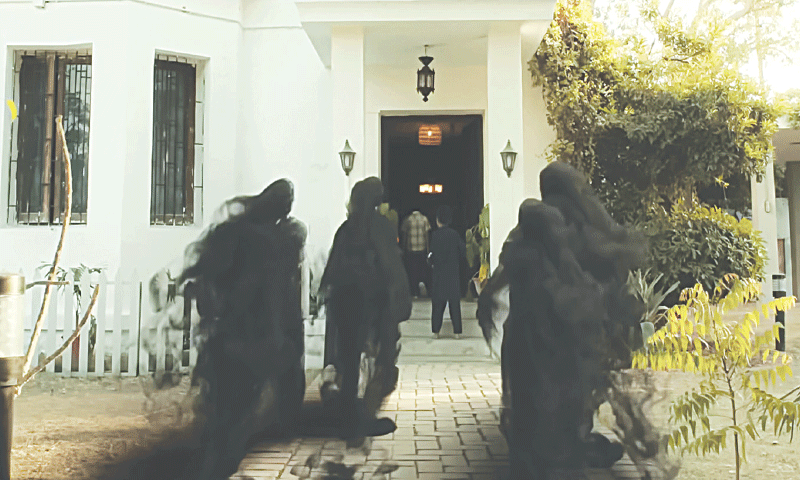
As with most nuanced elements of the story, the screenplay promptly forgets about the termites, choosing to indulge in half-hearted jump scares or showing us glimpses of djinns in ethereal black smoke forms, or human-like guises made with cracked molten soil-like skin.
The family learns of the demonic infestation late into the film — one seemingly nurtured by psychological issues that have “seeped into the walls like a sponge” — and remains unaffected by the Holy Quran’s daily recitations.
By now the viewer ends up with questions: what do the djinn want, and how does one retaliate against a supernatural enemy? It would have been great if the film had given those answers with conviction.

Bushra Ansari’s late entry, playing a saintly woman who is not an exorcist — there are no exorcisms in the film w— explains away that, spoiler alert, the djinns want this home after theirs was destroyed by an earthquake, and that they were invited inside by someone who lived there (apparently, like vampires, the djinns need permission to enter someone’s house).
The climax is unsatisfactory and without a high-point, with the film having asked a lot of questions but having left the answers up in the air. That’s not to say that this is a bad film — a narratively weaker film, yes, but certainly one of the better ones from Pakistani cinema.
Rafay Rashdi has become smarter as a director since Thorra Jee Le, and he is aided by cinematographer Rana Kamran and editor Rizwan AQ’s skill set. The cinematography and editing, coupled with the production design — and half-supported by an effective but unrelenting background score by Suhaib Rashdi (it would have been great if the score stopped at some point) — is buttressed by powerful performances from Bushra Ansari, Sonya Hussyn and Faysal Quraishi. Samina Peerzada is fine, hamming it up and playing it under when needed.
Contending with superficially written roles — a disservice to both Hussyn and Quraishi — the two actors prove that they can carry the uneven load of an undercooked yet good-looking horror film with absolute ease.
Released by Mandviwalla Entertainment, Deemak is rated PG, and features djinns that love to short out electricity and tamper with faucets that either don’t stop leaking or gush blood for no reason at all
Published in Dawn, ICON, June 15, 2025