Pakistan delegation kicks off diplomatic offensive with UNSC meetings


 0
0


WASHINGTON: The Pakistani political delegation, which kicked off its diplomatic outreach on Monday in the wake of conflict with India, has urged global powers to reject New Delhi’s dangerous “new normal” of aggression.
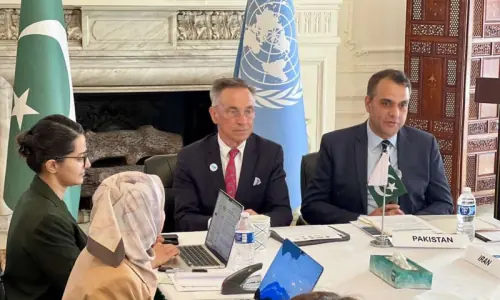
The nine-member Pakistani delegation, led by PPP Chairman and former foreign minister Bilawal Bhutto-Zardari, held a series of meetings at the UN Headquarters in New York. They engaged with envoys of the Security Council’s permanent members, beginning with China’s Ambassador Fu Cong.
While talking to reporters after the meeting, Mr Bhutto-Zardari said the delegation “reiterated Pakistan’s commitment to the ceasefire, regional stability, and a peaceful resolution in accordance with the UN Charter”.
He said the international community must reject India’s dangerous “new normal” of aggression.
The term refers to India’s increasingly assertive military posture and unilateral actions, which Pakistan views as destabilising and in violation of international diplomatic norms.
In its meeting with China’s envoy, the Pakistani delegation thanked Beijing for its “unequivocal support” in the face of Indian provocation.
Mr Bhutto-Zardari briefed Ambassador Fu on the developments following the April 22 Pahalgam attack and Pakistan’s “responsible and restrained conduct” in response to India’s “belligerent posture.”
He noted that Pakistan’s offer of “credible, impartial and independent investigations” into the attack was regrettably rejected by India.
The Pakistani side also shared details of what it called “India’s arbitrary attacks on Pakistani territory,” its targeting of civilians and New Delhi’s alleged support for terrorism within Pakistan.
The delegation also criticised India’s move to suspend the Indus Waters Treaty, calling it “a weaponisation of water and a violation of international law.”
“I condemned India’s reckless actions, including its weaponisation of water, and reaffirmed that Indian Illegally Occupied Jammu and Kashmir remains an unresolved dispute and a fault line for regional peace,” Mr Bhutto-Zardari told reporters.
In a separate statement, the former foreign minister reaffirmed Pakistan’s commitment to peace through dialogue.
“Pakistan seeks peace with dignity, dialogue with purpose, and partnerships built on justice.” He warned the unresolved Kashmir dispute “continues to threaten regional peace” and voiced concern over water security, stating that “any aggression over shared water resources challenges not just Pakistan’s sovereignty, but global stability”.
He also reiterated Pakistan’s position on terrorism. “We reject terrorism in all forms, yet oppose its misuse as a political tool to target Pakistan.” Emphasising economic cooperation, he noted that “trade must become a bridge, not a battleground.”
According to the statement, Pakistan and China agreed “aggressive posturing and unilateral actions threaten peace in the region and must be firmly opposed”.
The two sides reiterated their shared commitment to peaceful dispute resolution, multilateral cooperation, upholding the UN Charter, and preserving the sanctity of treaties and international law.
Later, the delegation met with US envoy to the UN, Ambassador Dorothy Shea, and expressed concern over India’s accusation against Pakistan following the Pahalgam attack.
They described the allegation as premature and lacking without any credible investigation.
Mr Bhutto-Zardari urged the US to encourage a comprehensive dialogue between the two neighbours. He also called for the resumption of talks on the Indus Waters Treaty.
The Pakistani delegation is scheduled to arrive in Washington today, where it plans to engage with Secretary of State Marco Rubio, other senior officials, lawmakers, and think tanks till June 6.
The visit coincides with the arrival of an Indian delegation in Washington on June 3, led by Congress MP Shashi Tharoor.
Published in Dawn, June 3rd, 2025