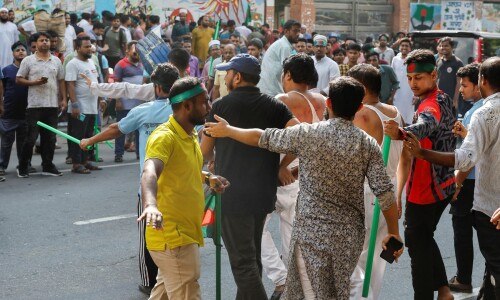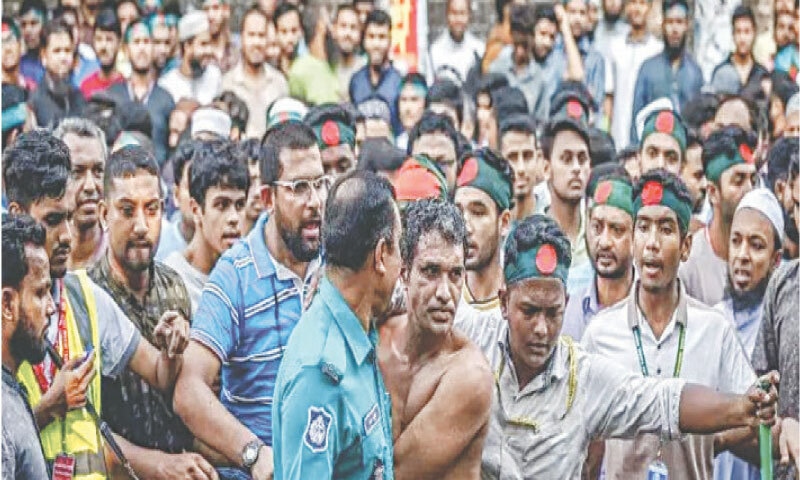

IN any democratic society, justice is a basic right. People expect that if someone is wronged, there will be legal protection. If someone is harmed, the law will respond. However, in today’s Bangladesh, that expectation is slowly fading. A dangerous trend is growing, where angry crowds take the law into their own hands, and people are punished without trial. This is mobocracy, and it is threatening our entire justice system.
Mobocracy means rule by mobs, where it is decided if someone is guilty without any investigation or judicial process. Unfortunately, we see this often in Bangladesh. Public anger sometimes takes over when someone is accused, before the truth emerges. Instead of the police and the court handling the situation, the public reacts with violence, and sometimes, this ends in tragedy.
On March 4 of this year, two Iranian nationals came under a mob attack in the Vatara area of Dhaka. The incident reportedly began when they visited a local business to exchange foreign currency. A disagreement arose, leading to suspicions that the Iranians were attempting a mugging. This suspicion quickly escalated into a violent mob attack against the two foreigners. After a call was made to the national emergency hotline 999, police arrived at the scene and rescued the victims.
Just a day earlier, a separate and tragic event unfolded in Satkania, Chattogram. Following the loudspeaker announcement from a mosque warning that robbers had entered the area, locals responded with mob violence. As a result, Nezam Uddin and Abu Salek were beaten to death in the Chan Khola West Para area of Eochia Union.
Similarly, on Feb 28, a group of drug users created a mob and assaulted an on-duty police officer Yusuf Ali, in Patenga, Chattogram. When he tried to stop some people from using drugs, some unruly youths labelled him as a fake cop and attacked him. Later, 12 people were arrested in connection with the case.
Lastly, the recent case of Rais Uddin, an imam who served at a mosque in Pubail, Gazipur, shows how dangerous this growing trend has become. He was accused of paedophilia, but before a proper investigation could take place, he was attacked by a mob. The police arrested him, and the court sent him to jail, where he later died.
This is a serious failure of the legal system. Whether the allegation was true or false, everyone deserves a fair investigation. Dying in such a situation is not just a personal loss; it is a public concern. This reveals that our system is not working the way it should.
According to people who knew Rais, the attack was pre-planned and driven by ideological rivalry. His differing views provoked hostility from opposing groups, according to his family. This brutal killing has led to strong condemnation from concerned citizens across the country.
What is even more concerning is that, despite clear video footage showing who the attackers were, not one of them has been arrested. In contrast, the attackers of National Citizen Party leader Hasnat Abdullah in Gazipur were arrested within only a few hours. So, why is there a different approach when it comes to Rais, who is also a citizen of the same country? Does justice only apply to those with influence or power?
Given all this, what kind of country are we becoming? One where mobs replace courts? Where police choose whose voices to hear? If this continues, justice will become a rare thing, and no one will feel safe, not even the innocent.
The growing trend of mob justice has led to a disturbing rise in incidents such as beatings, attacks, vandalism, looting, and even extrajudicial killings. These acts are not limited to actual wrongdoers; innocent and law-abiding individuals have also fallen victim. While incidents of robbery and mugging have increased on one side, the rise of mob culture has simultaneously become more severe.
People are taking the law into their own hands, often in some parts of the country, which is causing a rise in murders and other crimes. Alarmingly, even political rivals have been targeted in some cases, raising serious concerns among members of civil society about the erosion of justice and the rule of law.
If we truly want change, we need stronger and fairer institutions. Also, as citizens, we must stay alert and raise our voices, not just when injustice happens to someone we know, but whenever anyone’s rights are denied. We must demand an end to mob violence and ask for a future where people can trust the system again, where truth, law, and fairness matter more than anger or rumour. Because when justice is replaced by fear, and feelings replace facts, we all lose.—The Daily Star (Bangladesh)/ANN
Published in Dawn, June 2nd, 2025