
A good idea is like a sturdy web. It powerfully connects known and hidden realities by linkages in the mind. Sara Aslam investigates space and time through two guiding concepts, namely ecotopia and eco-thought. As she immerses in the sensory environment of Gumchi Bagh, she imaginatively projects her thoughts towards a sustainably imagined future.
Ecotopia refers to this future in which the activities of the Anthropocene era that have caused environmental destruction on a historically unprecedented scale have started to fall in balance with regenerative natural cycles. These themes were clearly on display at Aslam’s latest show.
‘Ecologies of Diversity: Plants, Art, Film’ was a solo show by Aslam at Koel Gallery, culminating from a year-long hybrid residency programme between Islamabad and Edinburgh. It was curated by Sana Bilgrami, whose family hosted the residency on their farm, Gumchi Bagh in Tumair, Islamabad.
When the subject of an artist’s investigation is a large and diverse terrain such as Gumchi Bagh, a challenge arises as to how best to represent the natural world while transforming it into art. In the midst of naturally organised complexity that is quintessential nature, the artist must make coherent choices from the array of subject matter, which includes micro elements like dispersing seeds, and ants and bees, as well as macro phenomena such as thunder and lightning, horizon and sky, and the differentiated vegetation of cultivated and wild plants.
Through an immersive art practice that interweaves sensory experience and environmental knowledge, Sara Aslam maps a path towards balance between humans and natural systems
Like a botanist-explorer, Aslam collects plant and seed specimens in tiny glass vials. She creates an intriguing canvas holder within which she straps the delicate vials. The seed holder is one version of a “life kit.” The other is a vest that resembles the apotropaic or talismanic vests that soldiers wore into battle. The vest is decorated with columns of fine black writing created by embroidery. These are recipes of health-bestowing herbs and spices from the natural pharmacy, such as turmeric and ginger, rose hips and papaya. Some of these recipes come from her mother’s collection.
Intricate, collage-like mind maps with micro-notes and drawings from her journal are displayed on walls. Pressed leaves intersperse with hand-drawn illustrations. They are reminders that nature has inspired and instructed the thought process of the artist.
Handmade hollow balls made with terracotta and soil mimic the gumchi [arbus precatorius] seed of the vine from which the Bilgrami farm takes its name, Gumchi Bagh. These are called ‘Time Capsules — preserving past in present for the future.’ The earthen balls are a significant recurring motif. The artist has photographed them on the grounds of the farm set within grass and moss and trees as a symbol of fertility and a promise of a better future. Within the gallery, Sara arranges the capsules within rings of soil like orbiting planets.
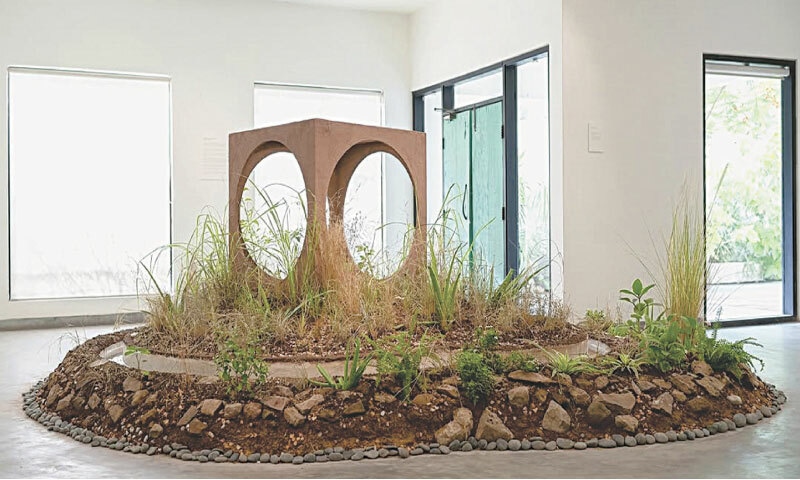
The most ambitious installation in the show is ‘Island — conceiving ecotopia.’ This is a living installation comprising live plants, a water rill, and a quantity of life-nurturing soil. Wheat germ seeds have sprouted and their upright form contrasts with the drooping blades of grass.
Art shows such as ‘Ecologies of Diversity’ spark discussion on commonly misunderstood ecological definitions of wild versus cultivated nature. Terms such as indigenous (naturally occurring in a specific region), naturalised (non-native species that have successfully adapted to the environment without causing harm to native species), and invasive (actively harmful to the introduced ecosystem) are often loosely applied to plantation schemes without a grasp of the ecological benefits and ramifications.
A talk between project consultant Noorjehan Bilgrami and Aslam invited questions on such issues. The role of indigenous knowledge from the cultivators of the land was also acknowledged in the discussion.
The notion of a sustainable future, though far from being a dominant reality, has come a long way from its speculative origins in Ernest Callenbach’s 1975 cult novel Ecotopia. The fictional narratives that urged rethinking about humanity’s collective survival have sufficiently sensitised attitudes across the globe today with regards to the thoughtless despoiling of Earth.
The cynicism brought about by failed idealistic schemes to reform humanity has ousted the elusive and unachievable Utopia in favour of the more pragmatic and achievable undertaking understood as ecotopia. A balanced approach to human-nature interactions lies at its heart and artists such as Aslam are at the vanguard of the new environmental consciousness.
‘Ecologies of Diversity’ was on display at Koel Gallery in Karachi from May 6-24, 2025
The writer is an independent researcher, writer, art critic and curator based in Karachi
Published in Dawn, EOS, June 1st, 2025