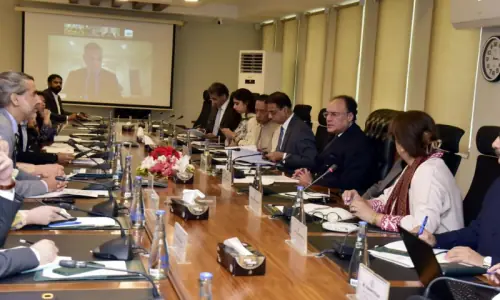
ISLAMABAD: The National Assembly Standing Committee on National Food Security and Research on Tuesday evaluated the impact of agricultural research on enhancing the national food security, raising concerns over the reliability of reported gains in crop productivity.
The standing committee meeting, chaired by Syed Tariq Hussain, heard a detailed briefing from the vice chancellor of the University of Agriculture Faisalabad (UAF), who explained that future projects will “focus on tackling climate change, enhancing water management, promoting mechanisation, and ensuring the smart utilisation of resources”.
He said key priorities include seed development, raising awareness, education, and the adoption of AI-driven climate-smart models. The vice chancellor highlighted notable research progress, including the development of ‘UAF-11’, a high-yield Brassica variety, and ‘Okra-3A’ for vegetable breeding.
Further advancements in soya bean, maize hybrids, mangoes, citrus fruits, and genetically modified sugarcane showcased the university’s dedication to improving crop yield, quality, and resilience, he explained. “Together, these initiatives play a vital role in strengthening national food security and advancing agricultural development,” he said.
Evaluates impact of agriculture research in enhancing national food security
However, the committee expressed concerns about the data presented during a meeting on Public Sector Development Programme (PSDP) schemes. The data claimed an increase in sugarcane yields from an average of 600 to 700 maunds per acre over five years under a ministry-funded project worth billions of rupees.
The committee pointed out that the data was sourced from sugar mills, “which tend to underreport production figures to evade taxes,” raising doubts about the accuracy of the reported increase. They also criticised that such a marginal improvement after years of investment “represents a poor return on resources and time”.
The vice chancellor also outlined challenges, including “policy gaps, security issues, water scarcity, budget limitations, and insufficient coordination between the ministry and its departments”.
Strategic agricultural plans encompass water and land management, technology and agricultural inputs, livestock and rural poultry, inland fisheries, rural development, agroforestry, monitoring and evaluation, agricultural research, and the promotion of market-based industries.
The university is collaborating with the Asian Development Bank (ADB) on DAP fertiliser production, import substitution, and precision agriculture. Efforts include integrating artificial intelligence, promoting solarisation, climate mitigation, and digitalising agricultural extension.
With 135 ongoing collaborations — 84 international and 51 national — the university supports outreach initiatives, such as Chinese language training for D-8 and OIC member countries.
Advanced labs
Additionally, PSDP and ADB-funded projects are establishing advanced laboratories for seed testing and certification to meet international export standards, while incorporating innovative technologies like AI, drones, and sensors to enhance agricultural research and practices, the vice chancellor added.
He also highlighted key focus areas such as “genetics, seed and breed improvement, agronomic best practices, agro-technology, and value addition efforts”.
Hybrid technology was discussed as vital for crop productivity. Special attention was given to developing durum wheat varieties requiring fewer inputs.
Mr Hussain, the committee chairman, stressed the “need to shorten crop life cycles as a means to reduce the use of critical resources like water and pesticides”, adding that this would alleviate farmer workload.
Published in Dawn, May 28th, 2025