ARTIFICIAL Intelligence (AI) is reshaping societies, economies, and governance. But as the UNDP 2025 Human Development Report, Whose Tech? Our Choices, reminds us, this transformation is deeply human. UN Secretary General António Guterres warns: “Humanity’s hand must be firmly in control of technology.”
Global inequality is widening, and Human Development Index progress is stalling. For Pakistan, the challenge is real. The latest HDI ranks the country 168th out of 193, placing it in the low development category. This decline stems from economic pressure, limited digital access and structural constraints. Yet this trajectory can be reversed — with vision, investment, especially in human capital — and long-term commitment.
UNDP Pakistan’s 2024 National Human Development Report Doing Digital for Development, argues that there can be no meaningful human development without digital progress. Of 121 districts covered in the NHDR, half face low digital development. The richest 20 per cent have a Digital Development Index 15 times higher than the poorest, while women have a Gender DDI only 54.1pc that of men. These divides are not just technical — they shape who participates, who benefits and who is left behind.
While Pakistan expands digital access, the global focus has shifted to AI. France is already at the forefront. Determined to put the AI revolution at the heart of its scientific and industrial ambitions, President Emmanuel Macron announced at the 2024 AI Action Summit in Paris a 109-billion-euro investment in the coming years, mobilised from French and international sources, both public and private.
Pakistan can promote inclusive development through AI.
The summit produced the Paris Actions for AI — a global roadmap for responsible use of AI focused on ecological alignment, job creation and cooperation. France’s 2018 AI strategy led to the establishment of 81 AI labs — the highest concentration in Europe — and continued with the 2025 launch of INESIA, a national institute bringing together public and private actors to assess risks and support ethical AI systems.
Pakistan can draw from this model, promoting inclusive development through AI. The Ministry of Information Technology and Telecommunication’s draft national AI Policy outlines ambitious goals: integrating AI into curricula, establishing innovation centres and supporting SMEs, and training one million professionals by 2030. But policy must be matched by investment in institutions, infrastructure and human capacity — with a focus on equal participation of women and marginalised groups. In this regard, strengthening the overall investment environment in Pakistan is essential to successfully adopting cutting-edge AI technologies. This means creating a vibrant ecosystem shaped around universities, start-ups, incubators, and private companies — including foreign investors — to help spread AI more widely across society.
Pakistan’s youthful population and growing tech sector provide a strong foundation, and IT industries are expanding rapidly. In Punjab, an AI-based building detection system supports vaccination in remote areas. At Nust, AI tools diagnose tuberculosis and brain tumours with over 90pc accuracy. Universities like Quaid-i-Azam and Bahria are scaling up AI research, while 16-year-old Mahrose Zufran from Karachi developed a Sindhi-language calculator in just three days.
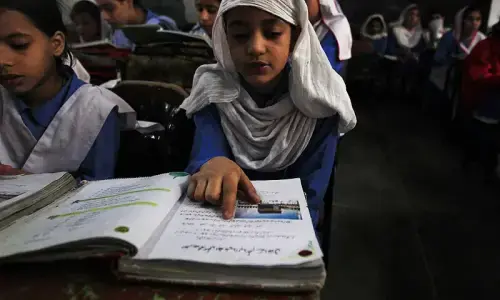
To realise AI’s promise, digital space must be grounded in fairness, transparency and inclusion. Around 42pc of Pakistan’s workforce holds routine-based roles, vulnerable to automation. Many are held by women. Meeting this challenge requires scaling up STEM education without snuffing innovation outside the classroom, diversifying digital skills training, and advancing digital spaces centred around people — not just profit.
Digital public infrastructure is critical. From reliable internet in underserved areas to strong data protection laws, Pakistan must build systems that reach all and uphold digital rights. These efforts must balance speed with care, innovation with equity and governance with trust.
AI’s benefits are not guaranteed. Without oversight, it could deepen exclusion, displace jobs and fuel misinformation. With thoughtful policy, public debate and global cooperation, AI can support sustainable development, create future-ready jobs, and strengthen democratic institutions.
At this juncture, Pakistan must decide whether to be shaped by technology or to shape it on its own terms. With principled leadership, coherent policy, and forward-looking partnerships — including between France and Pakistan — AI can become a force for dignity and shared progress.
Nicolas Galey is the ambassador of France to Pakistan.
Samuel Rizk is resident representative, UNDP Pakistan.
Published in Dawn, May 22nd, 2025