ISLAMABAD: Pakistani officials on Monday suspected that India triggered false alarm about the use of Shaheen missile during the military hostilities earlier this month as a deliberate fabrication, timed to support its post-conflict diplomatic surge and international lobbying effort.
By exploiting fears of nuclear escalation, they suspect, India sought to redirect attention from its own aggressive actions during Operation Sindoor and reinforce its narrative of moral and strategic superiority. The Indian action, therefore, highlighted the dangerous intersection of disinformation and nuclear signalling in a volatile region.
The baseless narrative, the officials, who spoke on background, argued is part of India’s broader strategy to frame Pakistan as a reckless nuclear actor amid mounting international concern over South Asia’s security volatility.
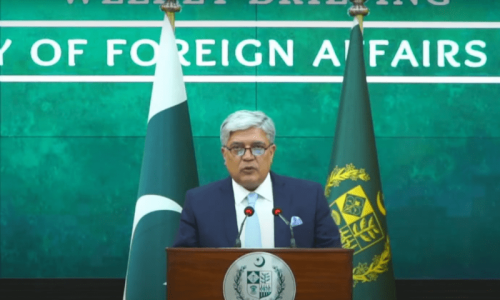
“The claim that Pakistan employed Shaheen-class ballistic missiles during the recent crisis appears rooted in a broader Indian — and now Western — effort to frame Islamabad as having crossed a nuclear red line,” a senior official told Dawn.
A video published and later quietly deleted by the Indian Army’s Western Command showed visuals of a Shaheen ballistic missile, sparking intense media speculation. Despite no official confirmation from Delhi, the video fueled allegations that Pakistan had used a nuclear-capable missile, even though no evidence supported such a claim.
Pakistani officials, therefore, believe the Indian move was an act of information warfare aimed at influencing global perceptions.
“The timing of this false narrative says it all,” the senior official stated. “It coincided precisely with External Affairs Minister Jaishankar’s diplomatic outreach to the Netherlands, Denmark, and Germany, and with the dispatch of seven multi-party delegations to key global capitals.”
The Indian intent appeared to craft a narrative of unity and resolve in the face of ‘terror threats,’ while stoking international fears about nuclear escalation.
“Its objective is twofold: first, to recast India as a restrained power responding to nuclear intimidation; second, to portray Pakistan as reckless and destabilising — a complete inversion of the actual crisis conduct,” the official added.
The Shaheen missile, a medium-range ballistic missile capable of carrying nuclear warheads, is among Pakistan’s most potent deterrent assets. Any suggestion of its use in an active conflict would signal a dangerous escalation.
Adding to the confusion, Indian media pointed to the Sarsawa Air Base as one of the Pakistani targets. Located over 400 km from the border, Sarsawa lies outside the range of conventional artillery and rockets, which some Indian analysts claimed as “evidence” of a longer-range ballistic missile being used.
Sarsawa base is a critical facility in Indian strategic programme.
However, Pakistani officials clarified that no Shaheen-class systems were deployed during Operation Bunyanum Marsoos.
The Foreign Office, categorically denying the use of Shaheen missiles, called Indian media claims “baseless and provocative”.
“The Ministry of Foreign Affairs has firmly rejected the unfounded allegations circulating in certain segments of the Indian media, which falsely claim that Pakistan employed the Shaheen missile during Operation Bunyanum Marsoos (BM).”
The FO statement emphasised that the operations, which targeted Indian military sites in response to India’s May 7 strikes on Pakistani and Azad Kashmir territory was conducted using precision-guided Fatah-I and Fatah-II missiles, long-range loitering drones, and advanced artillery.
The Fatah series, with ranges of up to 400 km, are non-nuclear, guided munitions designed for deep precision strikes consistent with the strikes reported on Indian installations.
“The recent conflict saw the effective use of conventional missile systems that met all strategic and tactical needs. Employing a strategic system like Shaheen — designed for existential-level threats — would have been unnecessary and doctrinally inconsistent,” the official, who spoke about the background, maintained ISPR described Operation Bunyanum Marsoos as a “textbook demonstration” of synchronised multi-domain warfare involving air, land, sea, and cyber forces.
The four-day conflict ended with a US-brokered ceasefire on May 10.
Experts view the false missile claim as a classic case of hybrid warfare which manipulated media and digital tools to seed doubt and provoke reactions. The FO noted the potential dangers of such tactics in a nuclearised region.
“Disseminating unverified and inflammatory content not only undermines regional stability but also reflects poorly on the professionalism of official institutions,” the FO said.
Published in Dawn, May 20th, 2025