0
0

ISLAMABAD: Pakistan is seeking loans totalling up to $350 million from commercial banks in the United Arab Emirates to meet its external financing needs.
According to informed banking sources, Finance Minister Muhammad Aurangzeb has been in discussions with these banks to revive their loan portfolio with Pakistan, and the finalisation of the loan is expected to occur very soon.
In the first three quarters of the current fiscal year, the government received about $504m from foreign lenders (mostly UAE-based), showing a minor recovery from commercial banks that had stayed away from financing Pakistan last year.
The government has budgeted $3.8bn in financing from foreign banks for the current fiscal year, but the actual realisation has been sluggish in the first nine months.
The government had also targeted $1bn in international bonds for FY25. Another projection of $9bn inflows from bilateral partners — China and Saudi Arabia — was targeted for the current fiscal year. These projections include a $5bn time deposit from Saudi Arabia and $4bn China’s SAFE deposit. These projections are critical for Pakistan to meet its external financing gap as part of the IMF programme.
Aurangzeb touts economic stability in talks with lenders
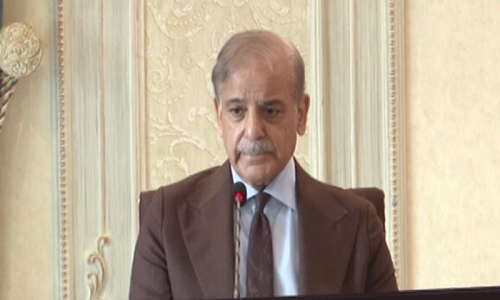
On Monday, the Ministry of Finance said it had held virtual meetings with three UAE banks — Sharjah Islamic Bank, Abu Dhabi Islamic Bank, and Ajman Bank — regarding their support for Pakistan’s development and fiscal objectives. Mr Aurangzeb led these discussions and interacted with the Standard Chartered Bank team.
He thanked Standard Chartered Bank and Dubai Islamic Bank for their leading role in organising these interactions with Sharjah Islamic Bank and Ajman Bank as potential partners. The loans of $350m would be backed by guarantees provided by the Asian Development Bank (ADB). The finance minister also appreciated ADB’s collaboration and support to the Ministry of Finance for supporting Pakistan’s fiscal and development goals.
He updated the managements of UAE banks about Pakistan’s steady progress toward macroeconomic stability, saying the country had come a long way and was on track to close FY25 with current account and primary surpluses as the forex reserves approaching $14bn, providing three months of import cover. He said inflation had eased to 0.3pc, and the policy rate had also come down significantly, showing a positive economic outlook.
The minister also informed the foreign banks about the structural reforms that formed the basis of this recovery and said the government was firmly committed to long-term reforms, including restructuring of state-owned enterprises, an active privatisation programme, and rightsizing of the federal government. “We have broken away from the old boom and bust cycle. Difficult but necessary reforms back the current stability — and we are staying the course,” the minister said in a statement.
On the revenue side, the minister said Pakistan was set to reach a tax-to-GDP ratio of 10.6pc by June, with a target of 11pc for the next fiscal year. The government is prioritising Federal Board of Revenue reforms and end-to-end digitisation to broaden the tax base and improve compliance, he said, adding the ongoing progress was backed by the approval of disbursement of the second tranche under the IMF’s Extended Fund Facility (EFF) and approval of $1.3bn under the new Resilience and Sustainability Fund (RSF).
“Pakistan has met all quantitative targets under the IMF programme and has also achieved key structural benchmarks, including the introduction of agricultural income tax — a milestone measure in the country’s fiscal history”, the finance minister said, adding the recent improvement in Pakistan’s sovereign credit rating by Fitch was a reflection of market confidence.
Looking ahead, the finance minister promised Pakistan’s shift towards a productivity and export-led growth model and pointed to robust growth in the IT sector, with exports reaching $3.4bn in March and momentum in the minerals and mining sector. He said the Reko Diq project stimulated interest in Pakistan’s mining potential, and the government aimed to leverage copper reserves for exports and energy transition.
Published in Dawn, May 20th, 2025