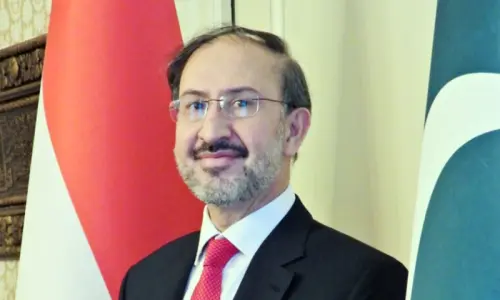
KARACHI: Expressing concern over the gravity of climate change challenges amidst growing burden of population, disease and environmental degradation, a US expert, during an online lecture held at Karachi University (KU), described plant-based medicines as key to global health.
He also called for interdisciplinary collaboration and increased funding to conserve the environment and reduce the global disease burden.
Plant medicines, also known as herbal medicines, involve using plants for therapeutic purposes, aiming to improve health or treat illness.
Dr Geoffrey A. Cordell, Professor Emeritus at the University of Illinois and President of Natural Products Inc., US, was speaking on The Future Role of Natural Products in Medicine Security.
The event was organised by the Unesco Chair on Medicinal and Bio-Organic Natural Product Chemistry at KU’s International Center for Chemical and Biological Sciences (ICCBS).
“Healing the Earth now is critical for human survival as the global climate is changing faster than expected. The year 2024 was the hottest on record in 170 years,” he warned, emphasising the need for immediate interventions to cool down the planet.
“The earth faces degradation, and weather events are getting more intense. The frequency and severity of droughts, floods, and fires have increased manifold. We do not have another planet, and our resources are limited,” he added.
He expressed concern over the weak human response to the multiple environmental challenges the world faces today, warning that global climate change is accelerating faster than expected and that Antarctic ice shrank to its lowest level in 2023.
“Economic inequality, both locally and globally, is widening, while the population continues to grow — with Pakistan’s population expected to increase by 46 per cent to 372 million by 2050, making it the fourth most populous country,” he said. On the future role of natural products, he stressed the increased role of artificial intelligence and machine learning in plant identification, monitoring, distribution and growth.
“Plant medicines are key to global health. Expecting big pharmaceutical companies to alleviate the disease burden is unrealistic. What we need is interdisciplinary collaboration and funding to conserve the environment and reduce global and local disease burdens,” he noted.
Prof Cordell also called for international collaboration in research, adding that “Healthy people need a healthy earth to live on, and for that, we all need to collaborate.”
Published in Dawn, May 19th, 2025