Istanbul talks laid bare Ukraine-Russia chasm


 0
0


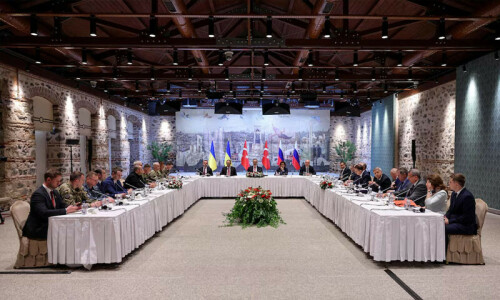
ISTANBUL: The first high-level talks between Russia and Ukraine since the early months of Moscow’s 2022 invasion showed they are far from agreement on steps needed for a ceasefire, even though they promised a major swap of prisoners of war.
A window for more diplomacy remains ajar, however, after the sworn enemies agreed in principle to hold further talks, the foreign minister of host country Turkey said, a crucial point for US President Donald Trump, who wants a rapid peace.
The negotiators’ promises to release a thousand prisoners of war, to meet again for talks and to present their vision for a ceasefire were “substantial steps”, said Peter Slezkine, a senior fellow and director of the Russia programme at the Stimson Centre.
“I do think that they are a very hopeful sign, because the two sides coming into direct contact is an important development,” he said.
Ukraine, the United States and other Western countries have called for a 30-day ceasefire without preconditions to allow for peace talks.
Russia, which controls almost a fifth of Ukraine, has shown little appetite for concessions, repeating maximalist demands such as Ukraine withdrawing from and recognising Russian control over four Ukrainian regions that the Kremlin now unilaterally claims as its own but does not fully control.
The measured tones of statements by both sides that followed the talks did little to paper over the chasm between them. A Ukrainian diplomatic source said that Russia made demands at the talks that were “detached from reality and go far beyond anything that was previously discussed.”
The source, who declined to be named due to the sensitivity of the talks, said they included ultimatums for Ukrainian forces to withdraw from some of its own territory and “other nonstarters and non-constructive conditions.”
The Kremlin’s chief negotiator Vladimir Medinsky suggested after the negotiations that Russia could fight on for as long as it needed to achieve its aims. Invoking tsarist military victories in a 21-year war against Sweden in the 18th century, he said Kyiv was merely deepening its own demise by resisting Russia’s peace demands.
‘Beginning of the journey’
The closest things to a blueprint for a peace deal that have yet to emerge are proposals circulated by the United States and counterproposals suggested by Europe and Ukraine at talks last month.
On Saturday, a senior Ukrainian government source said Russia’s latest demands in Istanbul included Kyiv renouncing its desire for reparations, international recognition of five parts of Ukraine as Russian and that Ukraine becomes a neutral state.
The demands went further than either the US or Ukrainian and European proposals. One of the senior Ukrainian officials who took part in the abortive series of 2022 talks with Russia that failed to stop the all-out war said that the outcome of the renewed engagement in Istanbul had panned out entirely as expected.
“Every journey begins with a single step. This is the beginning of the journey. Demands are always exaggerated at the start of any negotiations. That’s classic,” the source said.
Setback for European push
The fragile outcome of the talks puts the ball once again in Trump’s court. He abruptly changed tack on Thursday, a day before the negotiations, saying he needed to meet Russian President Vladimir Putin for there to be a breakthrough.
His remark put paid — for now — to Europe’s hopes of pushing Washington to impose a fresh blast of sanctions on Russia.
If that happened, it would be a milestone moment in Trump’s fledgling presidency, during which he has so far shown sympathies towards Russia and torn up the pro-Ukraine policies of his predecessor, Joe Biden.
Just last weekend, the leaders of four major European powers travelled to Kyiv, threatening Russia with more sanctions if it did not agree to a 30-day ceasefire from May 12, a position they said the United States supported.
When Putin then suggested talks instead of a ceasefire, Trump told Zelensky in a social media post to immediately agree and made no mention of looming Russia sanctions, despite signalling for weeks that he is frustrated with what he has said could be foot-dragging by Putin.
Published in Dawn, May 18th, 2025