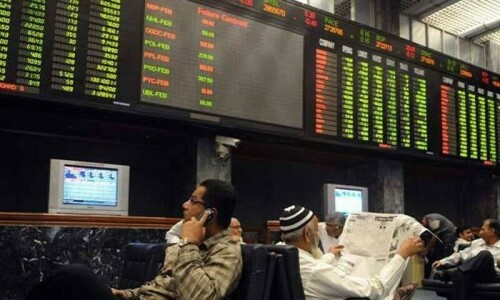
Uncertainty is believed to be the kryptonite of the markets and what can possibly create more panic than the threat of a full-scale war between two nuclear-armed states?
But investors often act strange, at least in the eyes of us plebs, as the last week showed. Even as India continued to disregard any respect for international borders and repeatedly targeted Pakistani territory and civilians via jets, drones and missiles, the behaviour of the local bourse was hard to figure out.
Soon after the first night of Indian attacks, the KSE-100 crashed intraday by 6,560.82 points before making some recovery to close 3,559.48 points or 3.13 per cent down. The following day was a bloodbath, with the index nosediving 6,482 points as tens of Indian drones flew and crashed across major cities in the country. However, security concerns took a back seat on Friday as the benchmark rallied by 3.5pc as the International Monetary Fund board review meeting drove the sentiments.
While that’s a relief to our economy at any time, the latest successful review is particularly important, considering that India actively lobbied to sabotage it. In the press release, the fund acknowledged Pakistan’s response, especially with respect to fiscal performance, which recorded a primary surplus of 2pc of gross domestic product achieved in the first half of FY25 and is on track to meet the fiscal year’s target.
Across the border too, rising tensions took a heavy toll on the market, losing around $83 billion of market value in two days, as per Reuters. However, the impact of the Indo-Pak war was not only limited to South Asian markets. The news of aerial dog fights between the two air forces, using French and Chinese jets, respectively, led to movements in the share prices of their manufacturers.
Panic was expected, but the timing and triggers of the stock markets tell a more nuanced narrative
Statements from the Pakistani military and subsequent confirmations by international media organisations that the Chinese-built J-10C, armed with PL15 missiles, managed to take down 4.5th generation Rafale’s was hailed by some as the “Deepseek” moment in aviation. Unsurprisingly, the shares of Chengdu Aircraft — the jet manufacturer from Shenzen — saw its shares surge by almost 23pc in the last five days. Meanwhile, Rafale’s maker, Dassault Aviation’s stock dipped 3.1pc over the same period.

Though uncertainty is bad for businesses and investors across the board, it certainly appears to have a stronger impact on the segment. As per data from Mettis Global, individuals happened to be the largest sellers, worth $17.2 million of equity between May 7 and 9, followed by mutual funds at $10m. On the other hand, companies bought $12.7m worth of shares.
Usually, when there are concerns of wars, local markets, and to an extent even the broader economy, are boosted by the performance of defence sector shares. Of course, that barely applies to Pakistan, where the bourse has little depth outside a few select sectors, and the military itself takes responsibility for manufacturing major equipment in-house. No wonder then that all but three sectors managed to close the past week in black while 34 ended in red.
Needless to say, this is just a short-term demonstration of what fear and security tensions can do to markets. The impact on the real economy, though harder to measure, is obviously far bigger, with T20 leagues of India and Pakistan becoming the first casualty as the two boards had to suspend them. God forbid if the situation drags along, the effects can be significant.
Indian airliners are already feeling the pinch of longer flight durations and higher fuel costs as Pakistan’s airspace became inaccessible to them. For us, temporary closures of civil air will further drag the still nascent industry and possibly cause heavy losses.
Economic costs aside, the most concerning aspect of this entire episode is the complete apathy of the international community about the risk of a full-scale war between two nuclear-armed states.
Perhaps it’s a good reminder of just how unimportant the region is to the world at large. When the dust has settled, the two sides should introspect: Pakistan on how to put its economy in order and India on the concept of international borders.
The writer is co-founder of Data Darbar and works for the Karachi School of Business and Leadership
Published in Dawn, The Business and Finance Weekly, May 12th, 2025