0
0

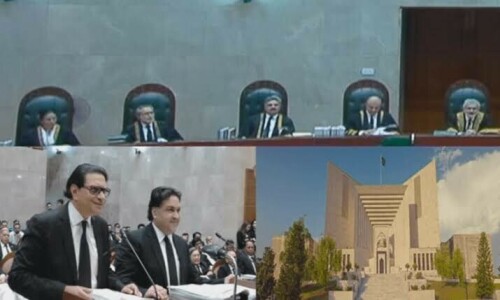
ISLAMABAD: Justice Aminuddin Khan, the head of a five-member constitutional bench that took up a PTI petition regarding election disputes, observed on Friday that the facility of suo motu may not be available any longer.
The observation came in response to the assertion of senior counsel, Hamid Khan, who cited the 2016 Quetta carnage inquiry by the Justice Qazi Faez Isa-led commission, and the 2011 Memo Commission inquiry, to lend strength to his argument that a judicial commission could probe the election disputes.
When the senior counsel, who was connected via a video link, said he had placed the additional documents related to the commissions on record, Justice Aminuddin reminded him that the matter was taken up by the court on a suo motu, a facility which may not be available now.
The counsel then referred to the 10-judge bench decision regarding the 2011 Memo Commission, in which there was a detailed discussion about taking cognizance of the issue on part of the Supreme Court.
Justice Mandokhail questions Hamid Khan’s plea seeking formation of judicial commission to probe rigging in Feb 8 polls; asks how an alternative forum can be created when election tribunals already exist
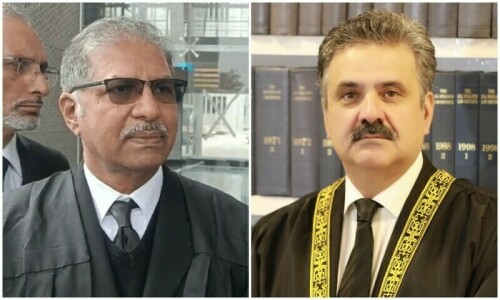
However, Justice Jamal Khan Mandokhail remarked that the counsel was referring to cases in which an alternative judicial remedy was not available.
“When there is an alternative judicial forum [available in the present case], how the constitutional bench can create a new forum on its own,” he said.
He reiterated that an alternative judicial remedy — election tribunals — was available under the Constitution to adjudicate electoral disputes.
Before returning the petition, which was filed by Mr Khan and his party, the constitutional bench at a previous hearing ordered removal of the objections raised by the registrar’s office.
Fallout on tribunal cases
During the proceedings on Friday, Justice Muhammad Ali Mazhar asked the counsel about number of election disputes pending before tribunals. He reminded the counsel what his client was seeking “may halt the entire process since all the cases before the tribunals will end”.
The counsel explained that no decisions had been made by election tribunals despite the lapse of a year.
When Justice Mandokhail asked him to advance arguments and identify errors in the objections by the registrar, the counsel requested for adjournment so that he may satisfy the court about the office objections.
Justice Mandokhail, however, said another adjournment was just not possible as the previous hearing, too, was postponed on the request of the counsel. “The case cannot be fixed again and again,” the judge remarked.
The counsel alleged that the registrar’s office had turned a blind eye to the petitions, which have political implications, while raising objections.
Objections overturned
Justice Aminuddin, after consulting with other judges overturned the objections of the registrar’s office with a direction to the office to allot case number to the petitions without assigning any next date for the case.
In his petition, the PTI sought immediate suspension of all consequential acts of forming governments at the federal and the Punjab levels until the findings of the judicial commission was made public.
The petition regretted that a political party having elected members in the national and provincial assemblies could not be deprived of the reserved seats.
A judicial commission, constituted in 2015 to probe PTI’s allegations of rigging in the 2013 general elections, concluded that polls were in large part conducted fairly and in accordance with the law. That commission was formed under a presidential ordinance on April 3, 2015 after months of a tug of war between the PTI and the PML-N in which it had recorded testimonies of 69 witnesses, including politicians, government and judicial officers and journalists.
In its fresh petition, the PTI emphasised that the courts could not turn a blind eye to the allegedly “obvious and apparent acts of high handedness, cruelty, oppression, suppression and violation of fundamental rights” on part of the caretaker government and the “illegitimately installed governments” at the federal and provincial levels.
Published in Dawn, May 3rd, 2025