0
0

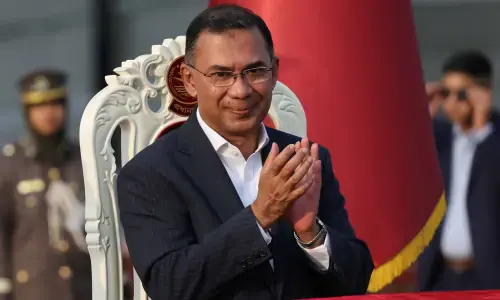
ISLAMABAD: Federal Minister for Planning, Development and Special Initiatives Ahsan Iqbal has said that India suffers from a severe insecurity complex, despite its larger size and population, and blames Pakistan for every incident that occurs there.
In a statement on Saturday, the minister said that despite having a population seven times larger than Pakistan, an expansive landmass and centuries of statehood experience, India continues to suffer from an insecurity syndrome.
In contrast, he added, Pakistan, with just 77 years of statehood and a comparatively smaller geography and population, exhibits greater composure and maturity.
Referring to the tragic Jaffar Express terrorist attack in Balochistan, Ahsan Iqbal noted that Pakistan responded in a responsible and mature manner by acknowledging internal security lapses and committing to addressing them, even while credible evidence pointed towards foreign involvement.
Conversely, he observed, India’s reaction to the Pahalgam tragedy in held Kashmir was impulsive and reactive, and rather than acknowledging its own security shortcomings, it hastily shifted blame onto Pakistan without any substantiated evidence.
PFUJ slams Modi govt for fuelling war-like atmosphere
‘War-like atmosphere’
Meanwhile, the Pakistan Federal Union of Journalists (PFUJ) has strongly condemned the Indian government, led by Prime Minister Narendra Modi, for pursuing a policy that fosters a war-like atmosphere in the region and undermines peace and harmony.
In a joint statement, PFUJ Acting President Khalid Khokhar and Secretary General Arshad Ansari called for an immediate halt to India’s uncalled for decision to suspend relations with Pakistan, particularly in areas such as the Indus Waters Treaty, trade and commerce, over an incident that remains under investigation and appears to be a false flag operation staged in Pahalgam, seemingly for political gains and to stir regional tension.
They pointed out that Pahalgam is located nearly 200km from the LoC and is heavily patrolled by Indian Border Security Force and the army, making the incident highly suspicious.
The PFUJ leadership warned that hostilities between the two neighbouring countries would only worsen bilateral relations rather than help bridge the already wide gap — created solely by the policies of India’s BJP-led government, which they said prioritises Hindutva ideology over secularism, a value India has upheld since its independence.
“Investigate the cause of the Pahalgam incident first, instead of blaming Pakistan for your own incompetence,” they added.
The PFUJ leadership also criticised the Indian media for promoting a policy of hate-mongering through the dissemination of false and fake content, a hallmark of Indian media during times of heightened tensions.
Published in Dawn, April 27th, 2025