Indian airlines to suffer higher costs, detours in ban from Pakistan airspace


 0
0


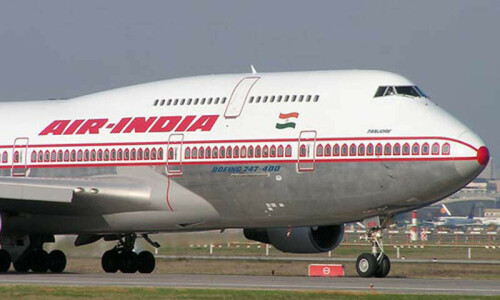
Indian airlines Air India and IndiGo are bracing for higher fuel costs and longer journey times as they reroute international flights after Pakistan shut its airspace to them amid tensions over a deadly militant attack in occupied Kashmir.
India has alleged there were Pakistani elements in Tuesday’s attack in which gunmen killed 26 men in a meadow in the Pahalgam area of occupied Kashmir. Pakistan has denied any involvement and demanded proof of any evidence.
The nuclear-armed arch-rivals have unleashed a raft of measures against each other in response, with India putting the critical river water-sharing Indus Waters Treaty in abeyance.
International airlines are not affected by the ban.
But late on Thursday, Air India and IndiGo began to reroute flights to New York, Azerbaijan and Dubai — all of which typically use Pakistan airspace, according to data from tracking website Flightradar24.
The worst-hit airport will be New Delhi, one of the world’s busiest, from where flights cross Pakistani airspace to fly to destinations in the West and the Middle East.
Data from Cirium Ascend showed IndiGo, Air India and its budget unit Air India Express have roughly 1,200 flights combined from New Delhi scheduled for Europe, the Middle East and North America in April.
Air India’s flights to the Middle East from New Delhi will take about an hour longer, which means more fuel and less cargo, said an Indian aviation executive who declined to be identified.
Aircraft fuel and oil usually make up about 30 per cent of an airline’s operating costs, by far the biggest component.
Flights cancelled or adjusted, pilot rosters to change
IndiGo said about 50 international routes may be adjusted slightly. It also said it was cancelling flights to Almaty from April 27 until at least May 7 and to Tashkent from April 28 until May 7.
Indian airlines’ expansion plans have already been complicated by delivery delays from Boeing and Airbus.
One Indian airline pilot told Reuters the ban would force airlines to redo their calculations on permitted flying hours and adjust crew and pilot rosters accordingly.
Another executive said staff at his airline worked late into the night on Thursday on the consequences of the ban.
Both spoke on condition of anonymity.
IndiGo flight 6E1803 from New Delhi to Baku on Thursday took five hours and 43 minutes via a longer route that involved going southwest to India’s Gujarat state and then over the Arabian Sea, before swinging back north over Iran to Azerbaijan, FlightAware data showed. The same flight, through Pakistan airspace, took 5 hours 5 minutes on Wednesday.
In 2019, India’s government said that the closure of Pakistan’s airspace for about five months caused a loss of at least $64 million to Air India, IndiGo and other airlines.