Sindh govt writes second letter to Irsa demanding closure of TP link canal



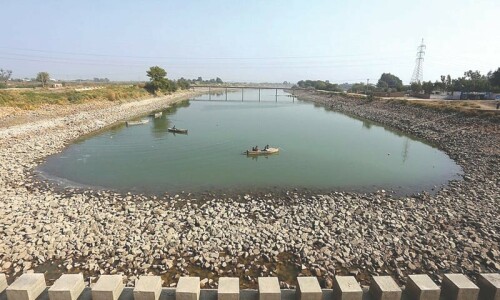
The Sindh irrigation department on Thursday sent a fresh letter — the second in the last 48 hours — to the Indus River System Authority (Irsa) to seek the immediate closure of the Taunsa Panjnad (TP) Link Canal to avoid water shortages in the province.
The canals controversy has deepened with Sindh Chief Minister Syed Murad Ali Shah strongly criticising the Punjab government for increasing water being diverted to the TP Link Canal, while Irsa claimed to have taken all decisions as per the law.
The Sindh government’s irrigation department on Tuesday wrote a letter to Irsa, requesting that the transfer of water from the Indus River to the Jhelum-Chenab system be stopped.
In the most recent letter, the regulation director expressed serious concern over opening the TP link canal, particularly in light of the inflow pattern observed in the Indus Basin Irrigation System and disproportionate shortages between Punjab and Sindh during the first ten days of April 2025.
The letter noted that the discharge of the TP link canal “increased from 2,981 cusecs on April 15 to 3,814 cusecs on April 16”.
The department requested that the operation of the link canal be stopped immediately and that the “Panjnad canal system may be fed through Jhelum river flows, ultimately [averting a] shortage in Mangla reservoir”.
Water flows are being stored in the Tarbela and Mangla dams, according to the letter. The Mangla dam, built over the Jhelum river, primarily feeds the Jhelum-Chenab (JC) zone. By March 15, it stored 1,050 cusecs of water, but by April 17, the dam’s storage stood at 1,111.95 cusecs.
“The inflow observed at Jhelum [at] Mangla has exceeded the minimum anticipated scenario by 20pc,” the letter read. “It is evident that water availability in JC System is much more than Indus System during 1st ten daily of April 2025.”
Similarly, the government noted that the Tarbela dam was a principal source of water supply for Sindh and Balochistan. On April 17, it stored 1,420 cusecs after reaching 1,402 cusecs in February.
The letter added: “Releases downstream of Panjnad should be made in accordance with the observed river inflow pattern, rather than by initiating the operation of link canals, as doing so could rapidly reduce water availability for the lower riparian provinces.”
Additionally, the letter warned that during the first ten days of April, water shortages were observed in both Sindh and Punjab. “To balance the water levels in Sindh, water would need to be released from Punjab.”
Meanwhile, Irsa on Wednesday issued a statement expressing concern that it “is being blamed that its decisions are biased”.
“The Authority is taking all decisions in accordance with [the] Water Apportionment Accord 1991 & IRSA Act XXII 1992 as per law,” the statement read. “IRSA Authority has passed a resolution that it has full confidence on all its members and Chairman.”
On February 15, Punjab Chief Minister Maryam Nawaz and Chief of the Army Staff Gen Asim Munir inaugurated the ambitious Cholistan project to irrigate south Punjab’s lands amid public uproar and strong reservations in Sindh. The Sindh Assembly also passed a unanimous resolution against the project in March.
The two letters, questioning the TP canal’s operation, attained attention due to the ongoing agitation in Sindh against the proposed construction of new canals and amidst fears that these canals, mainly the Cholistan canal, would divert water from the Indus River to southern Punjab.