‘Irrational’ Customs practices hurting trade with Iran



ISLAMABAD: A joint committee of the Senate has declared Pakistan Customs a key impediment to cross-border trade due to its use of “irrational” practices.
The Senate Standing Committee on Commerce and the Senate Standing Committee on Finance and Revenue convened their first-ever joint meeting to focus on the barter trade mechanism with Iran, a critical neighbouring trade partner.
Chaired jointly by Senator Saleem Mandviwalla and Senator Anusha Rahman, the meeting brought together key members of both committees.
However, the committees expressed strong displeasure at the absence of the Secretary of Commerce Jawad Paul and the Minister for Commerce Jam Kamal, terming it a serious disregard for parliamentary oversight on such a pressing national issue.
The committee unanimously agreed to revise the current barter trade policy with Iran. The new framework will ensure that neither Pakistan nor Iran suffers disadvantages in trade deals.
The joint committee will review the draft policy framework, and then a formal summary will be presented to the federal cabinet for approval. The committee gave 10 days and requested a report.
Trade movement, according to the chairmen of the committees, was being stalled over court stay orders, while customs authorities appeared content with policy stagnation and resistant to any change.
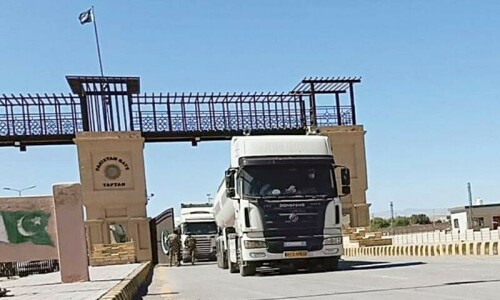
Iranian representatives apprised the committee of the gravity of the situation, revealing that 1,200 trucks — double the previously reported figure of 600 — were currently stuck at the Iranian border, causing immense losses to traders on both sides.
“Countries are not run on stay orders,” Mandviwalla asserted aggressively, pointing out that the customs authority went into slumber relying on judicial court orders for cross-border trade.
Both chairs unanimously pointed out the bureaucratic inertia and policy confusion that have not only paralysed legal trade but have also eroded Pakistan’s economic potential.
The committee identified the root of the crisis as a confusion between two overlapping trade policies. The first is the Barter Trade Policy, which permits only Iranian-origin goods to enter Pakistan. The second is the Import Policy Order, which mandates filing an I-Form for all imports.
This policy overlap, they noted, has rendered the barter trade mechanism a non-functional, bureaucratic exercise, further compounded by a lack of understanding among traders and the absence of an official banking channel between the two countries to support financial transactions.
Published in Dawn, April 17th, 2025