• Centre urges top court to dismiss all petitions challenging judges’ transfer to IHC
• Argues appointments from other courts are in keeping with ‘spirit of federalism’; fresh oath not required
• Justice Najafi sworn in as apex court judge; JCP meeting rescheduled for today
ISLAMABAD: The federal government on Wednesday told the Supreme Court that the real power to transfer judges from one high court to another lies with the chief justice of Pakistan (CJP), the chief justices of the respective high courts and the transferee judge, while the president has very limited say in this matter, under Article 200(1).
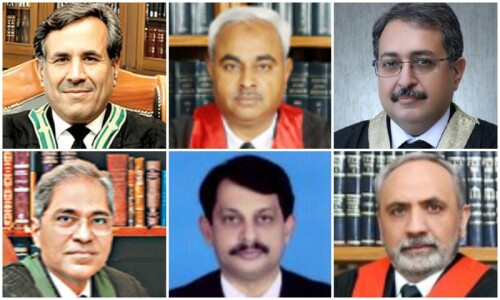
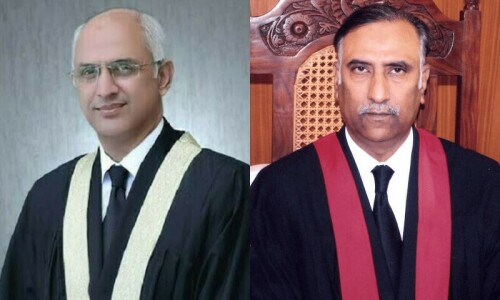
This explanation was part of a seven-page concise statement filed before the Supreme Court’s Constitutional Bench through Additional Attorney General Munawar Iqbal Duggal, along with a request to reject all the seven petitions, a day before the scheduled hearing of the petitions on the inter-se seniority of five sitting Islamabad High Court (IHC) judges.
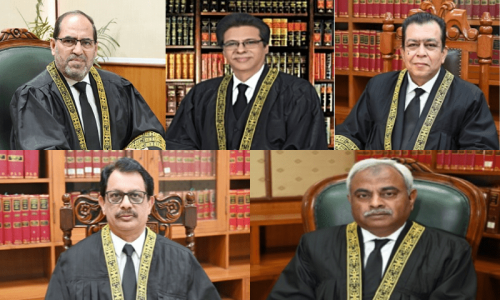
Headed by Justice Muhammad Ali Mazhar, a five-judge Constitutional Bench will resume hearing those petitions today (Thursday).
On the other hand, the Islamabad High Court Bar Association (IHCBA), one of the parties in the case, on Wednesday withdrew the constitutional petition it had filed before the Supreme Court in this matter.
‘Spirit of federalism’
The federal government, in its statement, explained that the consent of the judge being transferred and consultation with the CJP as well as of the respective high courts were conditions precedent to the actual transfer of the judge.
It further contended that the IHC must always be a representative court and its current serving judges were fully reflective of the spirit of federalism, pointing out that Justice Arbab Muhammad Tahir hailed from Balochistan, Justice Saman Rafat Imtiaz from Sindh (urban) and former chief justice Aamer Farooq belonged to Punjab.
In the present case, the transfer of judges from Sindh, Balochistan and Punjab, being the different federating units to the IHC, is in harmony with the spirit of federalism, the government said, adding these transfers ensure fair representation of the federating units and promote diversity in the high court in the common capital of the federation.
‘No fresh oath needed’
About the petitioners’ argument regarding mandatory fresh oath, the government argued that once a judge entered office, a transfer to another high court did not necessitate a fresh oath. “If this position [petitioners’] is accepted, then every time an additional judge’s term is extended in the high court, they would have to take a fresh oath,” it asserted.
A transfer under Article 200 does not equate to entering upon office and therefore the requirement of a fresh oath cannot be countenanced, the SC was reminded. Therefore, no fresh oath was required, the government said, adding that oath of all high courts, including IHC, was identical.
The transferred judges having already taken oath could not be required to take any other oath, which even otherwise was not provided by the Constitution, the government argued.
Article 200
It also explained that Article 200 was a code unto itself, laying out the structure of exercise of power to transfer high court judges.
Article 200(1) deals with the power of the president to transfer judges from one high court to another thereby attributing a clear permanence to the transfer. A lack of the term “for such period” or “during the period’ in Article 200(1) clearly reflects that the transfer is not in the nature of a temporary arrangement, the government added.
Permanency of transfer under Article 200(1) is also evident from the fact that to send the transferee judge back to his parent high court, the president will have to follow the entire procedure provided under Article 200(1) again.
The chief justice of a particular high court identifies the need to increase judges’ strength in that court, the government argued.
Besides, it added, Section 3 of the Islamabad High Court Act, 2010 provides that the IHC shall consist of CJ and 12 other judges to be appointed from the provinces and other territories of Pakistan, in accordance with the Constitution.
Keeping in line with the mandate of the said section and the sanctioned strength of IHC, on a summary initiated by the law ministry, the prime minister advised the president to authorise the law ministry to initiate process under Article 200(1).
JCP meeting today
Meanwhile, the Judicial Commission of Pakistan (JCP) has rescheduled its meeting from April 18 to April 17 to consider nomination of two more judges to SC’s constitutional bench.
The meeting, which has been rescheduled in view of the official engagements of some JCP members, will now held today at 3pm at the SC building.
Also on Wednesday, CJP Yahya Afridi administered the oath of office to Justice Ali Baqar Najafi, who was elevated to the apex court from the Lahore High Court by the JCP a few days ago.
Registrar Mohammad Salim Khan conducted the proceedings. SC judges, Attorney General for Pakistan, senior lawyers, officers of the federal judicial academy, law officers and officers of the Law and Justice Commission of Pakistan attended the ceremony.
Published in Dawn, April 17th, 2025