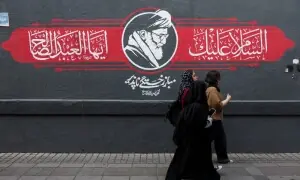
TEHRAN: Iran’s supreme leader Ayatollah Ali Khamenei said on Tuesday he was satisfied with talks with arch-foe the United States but warned they could ultimately prove fruitless.
Tehran and Washington are due to meet again in Muscat on Saturday, a week after top officials held the highest-level talks since the landmark 2015 nuclear accord collapsed. US President Donald Trump, who pulled out of the deal during his first term, revived his “maximum pressure” sanctions campaign after returning to office in January.
In March, he sent a letter to Khamenei urging talks and warning of possible military action if Iran refused. Saturday’s talks were “well carried out in the first steps”, Khamenei said, quoted by state television. “Of course, we are very pessimistic about the other side, but we are optimistic about our own capabilities.” But he added that “the negotiations may or may not yield results”.
IRGC says Tehran’s military capabilities are its ‘red lines’ in the discussions
Despite having no diplomatic ties since Iran’s 1979 Islamic Revolution, both sides described the talks as “constructive”. Iran insists discussions remain “indirect” and mediated by Oman.
Trump threats
On Monday, Trump again threatened to strike Iran’s nuclear facilities if no deal was reached, calling Iranian authorities “radicals” who should not possess nuclear weapons. Tehran denies seeking an atomic bomb, saying its nuclear programme is for peaceful purposes, especially energy production.
Khamenei said Iran’s “red lines are clear”, without elaborating. Earlier Tuesday, Iran’s Islamic Revolutionary Guard Corps said the country’s military capabilities were off limits in the discussions.
“National security and defence and military power are among the red lines of the Islamic Republic of Iran, which cannot be discussed or negotiated under any circumstances,” Guards spokesman Ali Mohammad Naini said.
On Monday, US Middle East envoy Steve Witkoff, who led the talks in Oman with Iranian Foreign Minister Abbas Araghchi, said Iran should return to the 3.67 per cent enrichment level stipulated in the 2015 accord. He said the process with Iran “is going to be much about verification on the enrichment programme and then ultimately verification on weaponisation that includes missiles, the type of missiles that they have stockpiled there and it includes the trigger for a bomb”.
‘Red lines’
In its latest quarterly report in February, the UN nuclear watchdog said Iran had an estimated 274.8 kilograms of uranium enriched to up to 60pc, close to the 90pc threshold required for weapons-grade material.
The head of the International Atomic Energy Agency Rafael Grossi is expected in Iran on Wednesday. Late Sunday, Iran’s official IRNA news agency said the country’s regional influence and its missile capabilities — long criticised by Western governments — were among its “red lines” in the talks.
Published in Dawn, April 16th, 2025