Need stressed for govt-private partnership in health sector, reducing reliance on external aid
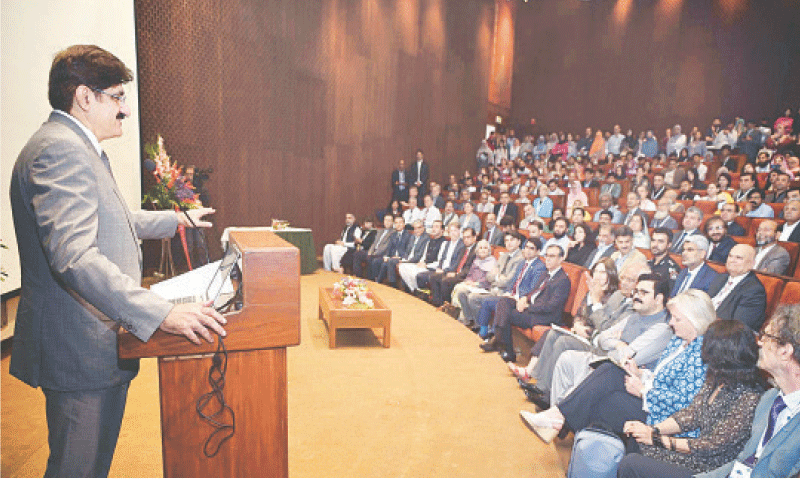
KARACHI: Speakers at a national symposium on primary healthcare held on Tuesday underscored the need for promoting health across sectors, improving access and service quality, enhancing government-private collaboration and reducing reliance on external aid.
Primary healthcare, they emphasised, was not just a component of the health system — it is its very foundation.
The event was organised by the Aga Khan University (AKU) in partnership with the federal ministry of national health services regulations and coordination and the provincial health department.
It was part of the Primary Health Care (PHC) Learning Agenda initiative, a two-year project led by the AKU and supported by the Gates Foundation aimed at generating evidence and enabling cross-provincial learning to enhance the PHC readiness and resilience.
CM advocates integrating health in all sectors at AKU seminar
“Real health progress requires a whole-of-government and whole-of-society approach,” said Chief Minister Murad Ali Shah in his keynote address, advocating for the integration of health in all sectors — from transportation planning to climate resilience.
He reaffirmed his government’s commitment to enhancing primary healthcare, highlighting efforts in addressing non-communicable diseases and enhancing community-based health delivery through programmes, such as the Lady Health Worker initiative, originally launched by late prime minister Benazir Bhutto in the 1990s.
“Health has always been a central focus of our policies and planning in Sindh,” Mr Shah stated, adding that the COVID-19 pandemic further highlighted the urgency of establishing a resilient health system, with primary care at its heart.
Mr Shah outlined several key reforms and investments from the provincial government, including improvements in the tertiary care and a targeted expansion of primary healthcare services.
“Since the devolution under the 18th Amendment, Sindh has significantly increased its health budget, especially in preventive and primary care,” he said, while acknowledging that there were still challenges despite progress and emphasising the need for public-private partnerships in health service delivery, particularly in urban environments.
In his remarks, AKU president Dr Sulaiman Shahabuddin said that primary healthcare was the path to a future where health systems would be people-centred, and where care would be accessible and equitable.
“That is the kind of system we need if we are to achieve universal health coverage and the health-related Sustainable Development Goals in Pakistan,” he said, adding that initiatives like the PHC Learning Agenda would help transform policy and practice across Pakistan.
The symposium highlighted five priorities for strengthening primary healthcare: integrating health and population services to address rapid population growth; reconfiguring primary healthcare to tackle non-communicable diseases and mental health; partnering with the private sector; improving service quality; investing in domestic health financing and reducing reliance on external aid.
Backed by the Gates Foundation, Unicef, and the World Bank, the symposium also featured discussions around financing, governance, health information, quality of care, and community engagement.
“Primary healthcare is central to achieving universal health coverage and health-related SDGs,” stated federal health minister Syed Mustafa Kamal in a pre-recorded video message.
“The government remains committed to prioritising primary healthcare reforms by strengthening public private partnership, benefiting from digital health, and ensuring that every Pakistani has access to essential health services.”
The symposium brought together government leadership policymakers, health experts and development partners to explore innovative solutions and research-driven strategies for achieving universal health coverage.
Prominent figures in attendance included State Minister for Health Dr Mukhtar Ahmed Bharath, Provincial Health Minister Dr Azra Pechuho, Minister of State for Health, Punjab Health and Population Minister Imran Nazir and Balochistan Health Minister Bakht Muhammad Kakar.
Published in Dawn, April 16th, 2025