• PM adviser Haroon Akhtar says Washington will be engaged to minimise tariff impact on exports
• Industrial policy and bankruptcy law will be introduced soon
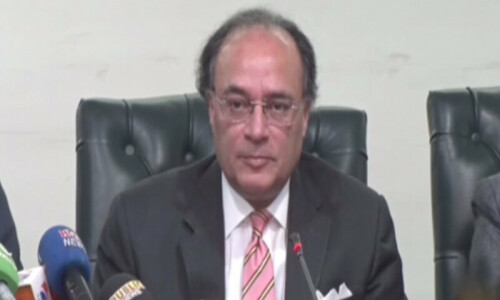
KARACHI: Haroon Akhtar Khan has said a firewall will be created to protect the corporate sector from undue harassment from agencies like NAB, FIA and FBR. Additionally, a new bankruptcy law will be introduced soon, along with a comprehensive industrial policy.
Speaking at the Karachi Chamber of Commerce and Industry (KCCI) on Saturday, the Special Assistant to Prime Minister (SAPM) for Industries and Production Division said the firewall would require any investigation into corporate entities to be vetted first by SECP, SBP, FPCCI and KCCI.
“We want to prevent arbitrary action against legitimate businesses. This firewall is not meant to protect wrongdoers but to ensure that honest entrepreneurs are not harassed,” he asserted.
He revealed that for the first time, Pakistan will have a comprehensive industrial policy, adding that an internationally reputed consultant has been hired to assist in formulating this policy, ensuring it meets global standards and is tailored to Pakistan’s economic context.
Mr Haroon underscored the need for a robust industrial policy that fosters export-led industrialisation, reduces import dependence, and builds foreign exchange reserves.
“We must prioritise domestic investors before looking outward. Our policies should focus on strengthening local manufacturing capacity,” he said.
Bankruptcy law
The adviser announced that a new bankruptcy law will soon be introduced to provide struggling businesses with legal avenues for restructuring and continuity. Additionally, committees are also being formed for the revival of sick industrial units and other issues that are the government’s top priority.
The Small and Medium Enterprises Development Authority (SMEDA) will undergo complete restructuring. Under the new vision set by the Prime Minister, the authority will be transformed into a dynamic and results-driven institution, supported by world-class consultants to make it truly effective in supporting SMEs, he said.
He said the Ministry of Industries will be restructured and its scope expanded to serve as the central hub for all industrial and manufacturing affairs in Pakistan. He added that this is part of the government’s broader strategy to place industry at the heart of economic planning.
On access to finance, he said that a committee will ensure that credit facilities are not limited to blue-chip companies but are extended to SMEs and the agricultural sector.
Regarding ease of doing business, Mr Akhtar criticised the current system, which requires as many as 350 possible certifications to start a new business, of which most of the NOCs are provincial subjects.
Addressing the issue of capital flight, he said a high-powered committee will be formed to investigate why Pakistanis are reluctant to retain or bring back their wealth. The committee will propose mechanisms to encourage nationwide investment in brownfield and greenfield projects.
Mr Akhtar acknowledged that tax rationalisation remains a major challenge due to constraints from international lending agencies such as the International Monetary Fund. However, he stressed that meaningful steps can still be taken within the next two years to reduce unnecessary burdens and promote economic activity. He suggested that savings from reduced electricity tariffs could be redirected to cut power costs and lower corporate tax rates.
He emphasised that the government is now on a path to recovery, citing the 10 per cent reduction in the policy rate as a key step toward economic revival. ”We are confident that with declining inflation, interest rates will fall further,” he added.
Strategy on US tariffs
On the 29pc US tariff, Mr Akhtar said Pakistan is ready to engage in dialogue and that a delegation may be sent to Washington to negotiate mutually beneficial trade terms. “We understand how the US administration operates. We will not retaliate but rather seek a constructive negotiation that minimises the impact on our exports. Every crisis brings an opportunity, and we are prepared to turn this challenge into an advantage,” he added.
Haroon, in a meeting with members of the Pakistan Business Council (PBC) and Korangi Creek Industrial Park (KKIP), said Prime Minister Shehbaz Sharif has a vision to turn the economy around, and digitisation is the key agenda point of the premier, who is also determined to bring about change.
Replying to a question on super tax, he clarified that it will be abolished.
PBC members urged the SAPM to strongly advocate with the USA on new tariffs and for the use of unutilised industrial assets.
Published in Dawn, April 13th, 2025