A high-school drama competition in Kenya was overshadowed by high drama of its own, after police fired tear gas to disperse a crowd that had gathered to watch a controversial play, BBC News reported.
The play, Echoes of War, is set in a fictional kingdom where the youth have lost faith in their leaders.
It features battles with the police and has drawn parallels with last year’s protests by young people against tax hikes.
It was initially disqualified from the drama festival under unclear circumstances, but a court ruling overturned the decision.
Tensions flared in the western town of Nakuru on Thursday morning when the student performers stormed out of the venue, demanding the release of the play’s author, Cleophas Malala, who had been detained by police.
The scriptwriter and former senator who penned the production for students from Butere Girls High School, was blocked by police from meeting the performers for final rehearsals on Wednesday evening, BBC News reported.
He was later released without charge and praised the students for boycotting the play.
“The young girls of Butere Girls’ have exercised an act of heroic restoration. I’m determined to ensure that Echoes of War is displayed before a Kenyan audience,” Malala said immediately after his release.
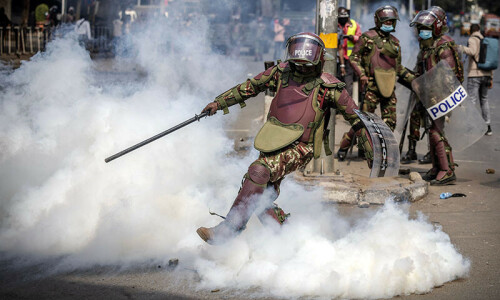
The students briefly sang the national anthem before dramatically leaving the hall, which was sealed off by anti-riot police, armed with batons and tear gas canisters.
“There’s no audience. Who are we performing for?” one of the girls told journalists.
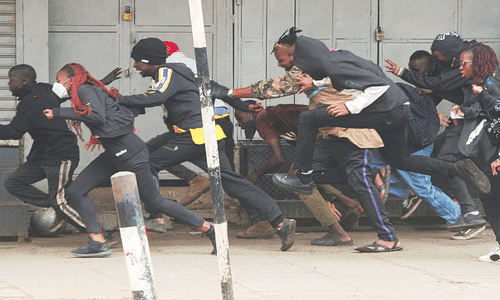
Following news of Malala’s arrest, large crowds had gathered outside the venue curious to watch the play.
But according to BBC News, anti-riot police had been deployed overnight in case of trouble and they fired tear gas to disperse the would-be audience.
The row has sparked public uproar, with rights group Amnesty International saying it was “pointing to a worrying pattern of state-sponsored repression of free expression, press freedom, and the right to associate”.
The fictitious kingdom in Echoes of War is ruled by a tyrannical sultan who is irked by the activism of the youth, portraying similarities to what is currently happening in Kenya, where young people have been demanding better governance.
It is not clear whether the play will now be disqualified and so not get through to the finals, which are held at State House with the president in attendance.
The annual high school drama competitions are hugely popular in Kenya, with students often using theatre as a tool to challenge those in power.
This is not the first time one of the plays has angered the authorities. In 2013, Malala made headlines with his controversial play Shackles of Doom, which thrust him into the national limelight — and eventually into politics.
The play, also performed by students of the same school, was banned by the government before a court ruled against the ban and allowed the play to be staged.
Published in Dawn, April 11th, 2025