



 0
0

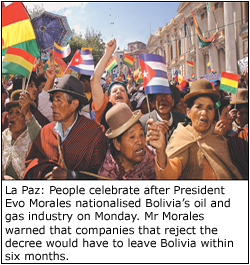 LA PAZ, May 1: Bolivian troops took control of oilfields as President Evo Morales issued a formal decree nationalising the country’s oil and natural gas resources.
The takeover of oilfields by the army’s engineering corps was announced by the top military command moments after the president announced a formal decree nationalising the country’s petroleum operations.
Mr Morales, at a May Day speech at San Alberto gas field in southern Bolivia, stated that the move would be a ‘true nationalisation that would help the economy and generate additional jobs in Bolivia.
The left-wing president said foreign energy companies would have to agree new contracts with the state-run oil firm, Yacimientos Petroliferos Fiscales Bolivianos (YPFB), within 180 days.
He said the state-owned YPFB would be responsible for all oil and production and sales, as well as prices, in the industry.
The president indicated that ‘only companies that respect these new terms will be allowed to operate in the country after the 180-day transition period.
“At the end of this period, companies that do no sign new contracts will not be able to operate in the country,” he added.
The deployment of troops ‘seeks to ensure the functioning of oil facilities to guarantee the normal supply of energy in accordance with international agreements as well as to fulfill domestic needs, an army statement said shortly after the president’s announcement.
Mr Morales was elected in December on a pledge to take a bigger share of earnings from Bolivia’s vast energy resources for South America’s poorest country.
Bolivia has the second highest natural gas reserves in Latin America, behind Venezuela. It has an estimated 54 trillion cubic feet of natural gas reserves, according to official data.
The measure is expected to affect about 20 foreign oil companies, including Spain’s Repsol, Petrobras of Brazil, Britain’s BP and British Gas and French group Total.
The details of the plan were not immediately clear. But Mr Morales himself has repeatedly said that the nationalisation of resources would not involve the confiscation or expropriation of oil companies’ assets.
The military document stated that the measure was part of an ‘intelligent nationalisation, which implies ... the negotiation of terms of equity and justice with oil companies.
Bolivia’s move comes after Venezuelan President Hugo Chavez clamped down on foreign oil companies that owe back taxes. Mr Chavez’s government also seized control of oil fields operated by Total of France and ENI of Italy after they rejected new operating accords requiring higher royalties to be paid to state-owned Petroleos de Venezuela SA. —AFP



























