0
0

• Indian, Bangladeshi leaders meet for first time since ex-PM’s exit
• Delhi urges Dhaka to avoid rhetoric that mars ties
BANGKOK: Muhammad Yunus, a Nobel Peace Prize winner who took over as the chief adviser of an interim government in Bangladesh in August after then prime minister Sheikh Hasina’s exit, met Indian premier Narendra Modi on Friday on the fringes of a summit in Bangkok.
“Prime Minister (Modi) urged … that any rhetoric that vitiates the environment is best avoided,” India’s foreign secretary Vikram Misri told reporters.
Modi and Yunus met on the sidelines of a summit in Bangkok of BIMSTEC, or the Bay of Bengal Initiative for Multi-Sectoral Technical and Economic Cooperation, a grouping that also includes Thailand, Myanmar, Nepal, Sri Lanka and Bhutan.
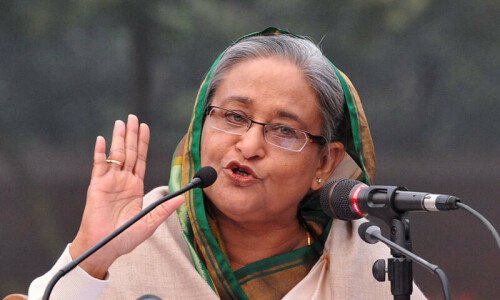
India was the biggest benefactor of Hasina’s government and her overthrow sent cross-border relations into a tailspin, culminating in Yunus choosing to make his first state visit last month to China.
Relations between the South Asian neighbours, which were robust under Hasina, have deteriorated since she fled the country in the face of massive student-led protests, and sought shelter in India.
Bangladesh described the 40-minute exchange between the two leaders as “candid, productive, and constructive”.
Yunus told Modi that Bangladesh wanted to work with him to set the relationship on the right track for the benefit of both countries, Yunus’s press office said in a statement.
Public opinion in Bangladesh has turned against India, in part over its decision to provide sanctuary to Hasina. New Delhi has not responded to Dhaka’s request to send her home for trial.
The two leaders discussed Bangladesh’s request seeking Hasina’s extradition, Misri said, without elaborating further.
“She has consistently made false and inflammatory accusations against the interim government of Bangladesh,” the statement from Bangladesh quoted Yunus as saying.
Yunus requested New Delhi take appropriate measures to restrain Hasina from making incendiary remarks while she remained in India, said the statement, adding that Modi said India did not support any particular party in Bangladesh.
India’s Misri said Modi had asked Yunus to help maintain border security and stability, and expressed his hope that Bangladesh would thoroughly investigate all cases of alleged atrocities “committed against non-Muslims”, including Hindus.
India has repeatedly urged Bangladesh to “protect Hindus’, alleging they were being targeted since Yunus took charge. Dhaka says the violence has been exaggerated and is not a communal issue.
“The hope would be that this meeting would start the process of rebuilding some engagement,” said Harsh Pant.
“I think at this point, simply stabilising the relationship should be the priority.”
With longstanding cultural and business ties, the two nations share a 4,000km border.
Published in Dawn, April 5th, 2025