0
0

ISLAMABAD: As Pakistan and Iran prepare for the spring locust breeding season, the Food and Agriculture Organisation (FAO) of the United Nations has started strengthening the capacities of its technical staff in the two countries.
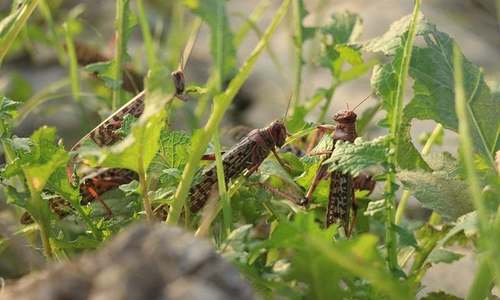
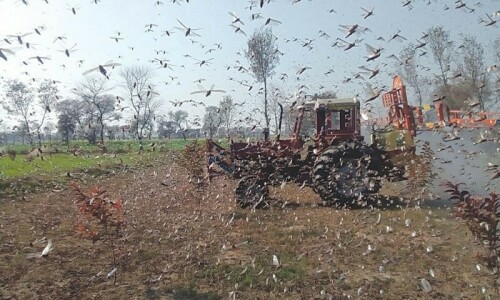
Pakistan is a frontline country for desert locust due to its two distinct seasons. During spring they are found in Balochistan while they spend the summer in Sindh and Punjab — along the Indian border in the deserts of Tharparkar, Khipro and Cholistan.
In Iran, locust infestations are usually found along the south-eastern coastal and interior regions of the country during the spring season.
The latest Desert Locust Bulletin of the FAO says during February, no locusts were seen in Balochistan along the south-western coast between Gwadar and Ormara, and from Lasbela to Karachi as well as in places near Turbat, Panjgur, Kharan and Nushki.
The bulletin forecast that isolated locusts may appear on the southwest coast and the interior of Balochistan, where a single generation of limited spring breeding could occur. But the FAO ruled out any `significant development’ as highly unlikely.
Training programme
To prepare for the breeding season, a regional training programme was conducted in FAO’s headquarters in Rome under the framework of the Commission for Control of the Desert Locust in South-West Asia (SWAC), which is FAO’’ oldest regional locust commission.
The desert locust information officers (DLIO) play a crucial role in locust management in affected countries. They are responsible for gathering field data, analysing it, and producing monthly bulletins that summarise the locust situation and provide forecasts to support decision-making and response.
It has four member countries: Pakistan, Afghanistan, India and Iran. Since 2008, DLIS has been conducting regional workshops for the DLIOs in collaboration with locust-affected countries.
Shahbaz, a DLIO from Pakistan, said the training improved his ability to analyse field data and transmit it to the FAO DLIS centre by using the new applications and tools.
He said he would now train 150 members of the field staff.
Keith Cressman, the FAO’s Senior Locust Forecaster, emphasised the importance of annual refresher training to ensure that locust information officers retain their knowledge and skills. He observed that these sessions help keep officers abreast with the latest advancements in locust control and management technologies.
Moreover, the training helps new officers joining national locust teams to develop the necessary skills.
Since desert locust outbreaks are a regular occurrence in parts of Pakistan, the government has a robust system of surveillance, control and treatment that predates independence.
In 2019, with the support of FAO, the Department of Plant Protection (DPP), under the ministry of national food security and research, surveyed nearly one million hectares and treated more than 300,000 hectares in Sindh, Balochistan and Khyber-Pakhtunkhwa, using 150,839 litres of pesticide.
Of the total area treated, nearly 14,000 hectares were cleared by aerial spray.
Published in Dawn, March 30th, 2025