Targeting visa holders



IT was an otherwise ordinary evening in Somerville, Massachusetts — a suburb of Boston. The last week of March had finally begun and the weather was warming up, heralding the arrival of spring.
Thirty-year-old Rumeysa Ozturk was going to join some friends for iftar. Ozturk, who has a Master’s degree from Columbia University in New York, was a doctoral student at Tufts University. Quiet and soft-spoken, Ozturk, a Turkish national, had a valid student visa and was a Fulbright scholar.
Video footage shows that six men approached Ozturk while she was on her way. All but one were masked. They were not in uniform and Ozturk’s terror is palpable in the video. The man whose camera captured the footage asked if this was a kidnapping. The men said they were from the police. In an instant, they had handcuffed Ozturk and spirited her away.
From the looks of it, the arrest seemed very well planned. Her attorney immediately filed a case in a district court in Boston. The judge signed an order asking the authorities not to move Ozturk out of the city, but it appears she has been taken out of Boston.
There is only one reason that can explain why Ozturk — a law-abiding PhD student without any criminal record and with a lawful student visa was arrested. A year before she was arrested, Ozturk along with some other students had written an op-ed in the student newspaper at Tufts University, criticising the response of the university administration to resolutions passed by the Tufts Community Union Senate.
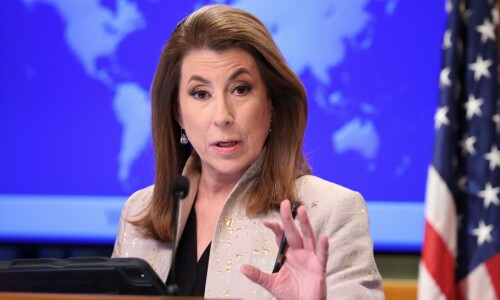
According to the article, “These resolutions were the product of meaningful debate by the Senate and represent a sincere effort to hold Israel accountable for clear violations of international law.” She has been detained by the US Immigration and Customs Enforcement (ICE) and, according to Secretary of State Marco Rubio, her visa has been revoked. “It might be more than 300 [visas] at this point. We do it every day. Every time I find one of these lunatics, I take away their visa,” he said.
Ozturk’s arrest came on the heels of the detention of Mahmoud Khalil, the Syrian-born Palestinian green card holder who is a Columbia graduate and married to an American citizen. He was detained apparently in the same ICE centre in Louisiana that Ozturk was taken to.
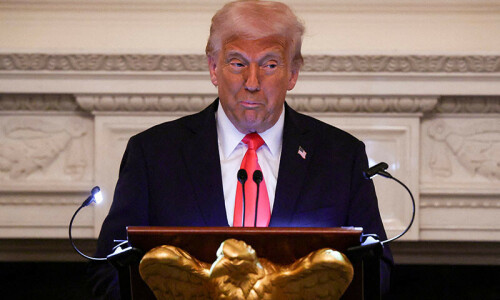
The Trump administration has weaponised the fact that visas can be taken away without any explanation.
Unlike Khalil, who has a green card, Ozturk only has a student visa. Visas can be revoked more easily than green cards, and under the Trump administration this fact has been weaponised as we can judge from Rubio’s remarks.
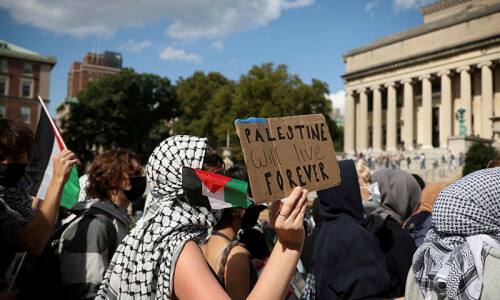
The fact that visas are ‘privileges’ that can be awarded or denied for any or no reason is being used as the basis of finding and then deporting students known to be pro-Palestine. Unlike Khalil who was acting as negotiator between students and the university administration, Ozturk did not appear to have been very involved in pro-Palestinian protests.
Worried foreign students are reportedly reviewing their social media accounts to remove any criticism of the Trump administration. Apparently, their social media accounts can be scanned via AI tools to find things that may be seen as critical of the US government. Normally, such statements were not a problem because agreeing with everything a particular administration sets out as its policies is not required to gain entry into the US. The Trump administration has weaponised the fact that visas can be taken away without any explanation.
The curbs on free speech are legally problematic. The First Amendment provides protections for freedom of speech and assembly. However, the Trump administration knows that visa holders whose free speech rights have been taken away are unlikely to be present in the US long enough to challenge their treatment in court. In the cases listed, for instance, the detentions have been fast and sudden.
In the post-9/11 era, people being arrested were charged with actual crimes such as providing material support for terrorism. However, in those cases, the government had to produce some proof to back its charges. But in the case of revoking visas, all sorts of allegations can be made against visa holders which do not require the provision of evidence since they have not been charged with any crime.
The consequence of all this is that all visa holders in the US feel unsafe. It is very possible that hundreds of thousands of them are scanning their social media accounts and removing criticism of the American state’s policies.
Meanwhile, the cases that have been filed, such as that of Mahmoud Khalil, are progressing in court. It is quite likely that in many such cases the ruling will be against the Trump administration.
The problem is that while this may be the eventual result, the speed at which the administration is carrying out these actions is such that the people most affected by them would already have been deported by the time their cases are heard. It would be naïve to think that the Trump administration does not know this. Clearly, the administration is willing to go to any lengths to ensure deportation — as it did of 250 Venezuelans, who were sent to El Salvador recently, by invoking an 18th-century law.
As in the aftermath of 9/11, American Muslims are in particular trouble. Most have opposed the war in Gaza and now the Trump administration is treating that political position as having provided support for Hamas, which it sees as a terrorist group. This puts all of them at great risk. The repeated persecution and deportation of innocent visa holders is normalising this kind of discrimination in the eyes of the American public.
In the meantime, the threat of travel bans still looms over everyone from mostly Muslim-majority countries. In less than 100 days of Trumpian rule, the US has already been transformed — seemingly, beyond recognition.
The writer is an attorney teaching constitutional law and political philosophy.
Published in Dawn, March 29th, 2025