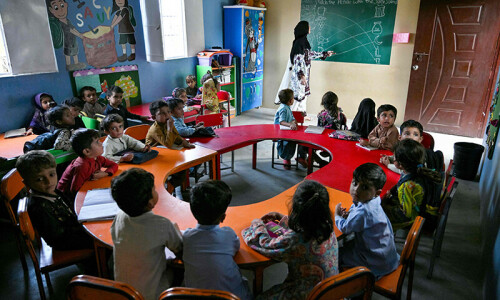
EVERY year, International School Meals Day is celebrated on the second Thursday of March, bringing attention to the importance of nutritious school meals in promoting child health, well-being, and learning.
This is especially crucial in Pakistan, where 26 million children aged five to 16 are out of school, contributing to the global crisis of 251m children worldwide without access to education. Worldwide, barriers such as poverty, food insecurity, gaps in school infrastructure, including classrooms, supplies, water, and sanitation, continue to prevent children from receiving an education.
Even among those enrolled, many children attend classes without breakfast, hindering their ability to concentrate, learn and thrive. A school meal programme implemented in government schools in Pakistan could be a transformative solution, encouraging the poorest families to send their children, especially daughters, to school. Once in the classroom, school meals ensure children are well-nourished and ready to learn.
School meals programmes are a multisectoral game changer that improve children’s education, health and nutrition. More broadly, they support the whole community by providing an important safety net, and by strengthening food systems and economies.
School meals are a strategic investment priority.
Global evidence shows school meals yield $7 to 35 in returns for every dollar spent. Studies show that these school meals programmes can be effective in improving nutrition and health, improving education outcomes, alleviating poverty, and strengthening gender equality by limiting school dropout among girls.
Global momentum is growing. The School Meals Coalition, a network of 100 governments and over 130 partners, is supporting countries expand policies and financing to ensure all children have access to nutritious meals by 2030.
The governments of Benin, Brazil, France, Germany, Honduras, Indonesia, Kenya, Nigeria, Paraguay, Philippines, Sierra Leone and Tajikistan are leading the push to expand school meals provision. As part of these efforts, Brazil will host the next Global School Meals Coalition Summit this September to share best practices and further drive action. Among measures announced ahead of the G20 leaders’ summit a few months ago were the following:
— Indonesia to launch its Free Nutritious Meal Programme in January 2025, positioning it among the largest school meal initiatives globally, reaching around 78m schoolchildren by 2029.
— The Philippines to double its investment to massively expand its school meals programme from 120 days to a full academic year, alongside a pilot rollout for universal feeding, reaching over 3m students and providing over 360m meals.
— Nigeria to relaunch its Renewed Hope National Home Grown School Feeding Programme feeding 20m children annually; launch school farms that will contribute 10 per cent of food items to school feeding, engage 250,000 smallholder farmers and aggregators in school feeding, and improve school attendance and reduce out-of-school children by 30pc by 2026.
Momentum is building in Pakistan since 2021, when the government of Pakistan endorsed the Global School Meals Coalition, committing to integrating school meals into national education and social protection plans.
Last year when Prime Minister Shehbaz Sharif declared an education emergency, saying, “Education is not an expenditure, it is the most profitable investment”, the Ministry of Federal Education and Professional Training also launched a school meals programme that targets 55,000 schoolchildren from 207 schools at the federal level.
Meanwhile, the World Food Programme partnered with the Balochistan Education Department to start a school meals programme, and over the first four months reached more than 13,000 children across 39 schools. This year, the initiative will expand to a total of 20,000 children in 65 schools. Discussions on how to start, scale and sustain school meal programmes are ongoing in other provinces.
With several South Asian countries recently establishing national legislation on school meals, Pakistan has a valuable opportunity to develop a similar framework. A strong legal foundation can ensure sustainable support and dedicated funding, ultimately benefiting students from the poorest families across the country.
As Pakistan is projected to become the world’s third most populous country by 2050, investing in human capital development through education, health and nutrition is more crucial than ever. Ensuring that children receive meals at school will not only improve their health but also boost their learning outcomes, paving the way for a healthier and more prosperous future for the next generation.
The writer is country director and representative World Food Programme.
Published in Dawn, March 15th, 2025