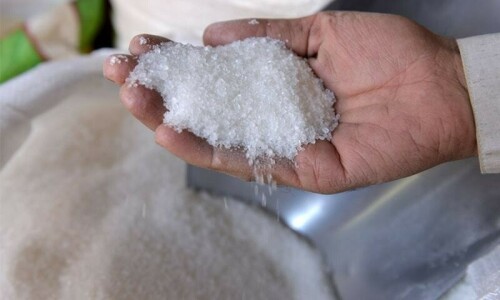
LAHORE: Barely a few weeks after exporting half a million tonnes of sugar, the federal government on Monday decided to import raw sugar to “stabilise prices” in the country.
According to an official statement, the import of raw sugar (Shakkar) would help bring down prices in the country and help increase future production, as it could be refined and converted into sugar locally.
Interestingly, the export permission was granted after the industry promised to keep domestic prices between Rs145 and Rs150 per kilogram. However, prices have increased to over Rs180 per kg in the last 10 days.
According to market observers, this kind of price surge during the crushing season is not only unprecedented, but also highlights the government’s lack of effectiveness and the industry’s credibility.
The industry has chosen to capitalise on the situation, making huge profits just weeks after promising not to do so. On the government’s part, it either appears unwilling or unable to hold the industry accountable or take administrative action against the defaulters, they observed.
“This is the circular motion we continuously travel in when it comes to governance, especially in protecting the public interest,” says Muhammad Amin, an irritated consumer.
According to analysts, the government’s decision to import raw sugar to control domestic prices is an absurd eyewash for two reasons: the time lag involved in importing and the nature of the problem itself.
Importing is a time-consuming process that could take the next 10 to 15 weeks, even if done on an emergency basis. By that time, prices will have already increased, and the industry will have made billions of rupees, achieving exactly what it wanted.
Secondly, the root cause of the problem is administrative, not a supply issue. The government has failed to make the industry honour its commitment.
“How can an import, whenever it arrives, solve an issue that is purely administrative? Sugar is not in short supply; the country is in the middle of the crushing season. Increasing supply won’t address the underlying problem,” Mr Amin wondered.
“With this import decision, the government only looks helpless, if not downright stupid, trying to deflect its failure onto the market,” insisted Ghulam Abbas, a trader from Lahore.
According to him, it’s a wrong decision to allow exports in the first place, as the permission was poorly informed, to say the least. With the import decision, which is equally ill-informed and aimed at deflecting the blame, the government will not only compound its mistakes but will also be guilty of prescribing the wrong solution a second time in one crushing season, he regretted.
Published in Dawn, March 11th, 2025