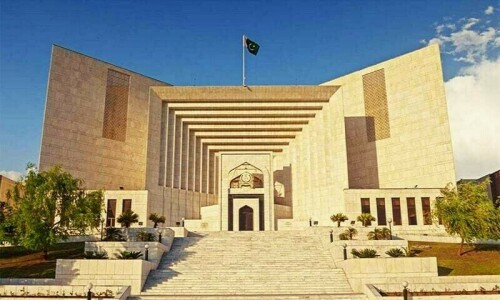
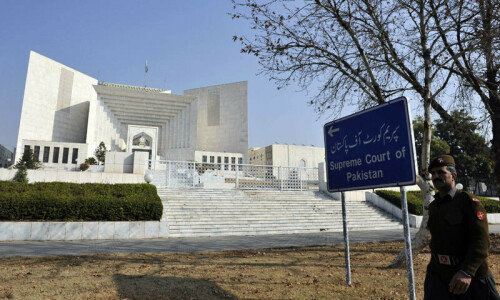
ISLAMABAD: The Constitutional Bench of the Supreme Court, hearing petitions against the military trial of civilians, has been urged to transfer the cases of civilians to the Anti-Terrorism Courts (ATCs.)
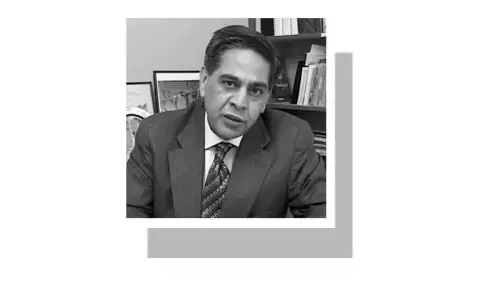
Faisal Siddiqi, who was representing civil society, proposed that the transfer of cases would be a “via media” — the middle way.
He added that if the trials conducted by military courts were invalidated, the cases of civilians handed maximum sentences by military courts should be sent to the ATCs, while the cases where convicts have completed their punishments should be considered “past and closed transactions”.
“If the court accepts my argument, the trial of civilians by military courts should be declared null and void,” Mr Siddiqi argued.
Faisal Siddiqi says power of officers to transfer custody of accused to army shouldn’t be unlimited
Headed by Justice Aminuddin Khan, the seven-judge CB resumed the hearing on a set of intra-court appeals filed against the court’s Oct 2023 order of nullifying the military trial of civilians involved in the May 9 violence.
The core issue in this case was the appropriate forum to try civilians, the lawyer argued, adding that civilians should be tried in civilian courts to ensure adherence to fundamental rights.
On Mr Siddiqi’s suggestion, Justice Muhammad Ali Mazhar remarked if he was seeking fresh trials of those already convicted for their involvement in the May 9 violence.
“If these cases are transferred from military to civilian courts, then from where would the trials should commence?” asked the judge.
He also questioned whether ATCs should treat evidence recorded during military trials as admissible.
The counsel contended that he was asking for a limited fresh trial by ATC of those who were awarded maximum punishments like six to ten years imprisonment.
Justice Khan, who was heading the bench, asked the counsel that if the concept of past and closed transactions was accepted, would it not mean endorsing military trials of civilians?
Unlimited authority
The court also questioned how it was decided which case would be prosecuted by military courts.
The question is not how 105 accused were selected for military trial, the counsel said, adding the question was whether the law allowed it or not.
Justice Khan then asked Mr Siddiqi if he had challenged Section 94 of the Pakistan Army Act, which deals with cases that can be tried in both civilian and military courts.
“When a criminal court and a court martial have each jurisdiction in respect of a civil offence, it shall be in the discretion of the prescribed officer to decide before which court the proceedings shall be instituted…”
The section alsostates that if “[an] officer” decides that the case will be tried in military court, the accused should be taken into military custody.
The counsel replied that the offence, which falls under the Army Act, was not determined when the custody of the accused was transferred to military courts.
He added that he had also challenged the “unlimited discretion” of Section 94 in his petition.
The authority of the officer who decides the transfer of custody to military courts should not be unlimited,“ Mr Siddiq contended.
When the discretion enjoyed by the prime minister is subject to certain limits, why the authority of the commanding officer to decide the transfer of custody was unlimited, the counsel argued.
He also emphasised the need for “structuring the power” to transfer the custody to military courts.
During the hearing, Justice Syed Hasan Azhar Rizvi observed whether investigations conducted by the police were slow and the ones by military authorities were swift.
He also questioned the evidence available at the time of transferring the custody.
The counsel, however, argued that the root cause was not the availability of evidence on record but the “unlimited power” exercised by the commanding officer in relation to the transfer of custody.
Justice Jamal Khan Mandokhail remarked whether the executive’s discretion ended after Article 175 of the Constitution — outlining the jurisdiction of courts — underscoring the judiciary’s independence from executive influence.
The counsel argued that the military trial of civilians was challenged before the Supreme Court under Article 245, which pertains to the deployment of armed forces in aid of civil power.
Justice Khan observed that when the events of May 9 took place, Article 245 had not been invoked by the government.
The counsel replied that Article 245 was in the field when the military trials were challenged before the Supreme Court. The hearing will recommence today (Tuesday).
Published in Dawn, March 4th, 2025