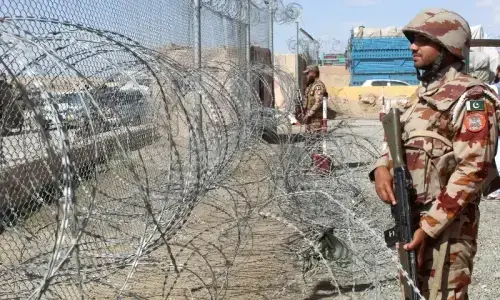
CONTROVERSY over demarcation of the common frontier is one of the key obstacles standing in the way of better Pakistan-Afghanistan relations; in fact, it has poisoned ties since this country’s independence. Disputes often lead to the closure of border crossings, causing suspension of trade and people’s movement. In this regard, the Torkham crossing has been closed for the past five days after the Afghan Taliban forces reportedly started building a bunker in a disputed area. Such closures have become far too frequent, as the underlying factors fuelling bilateral differences have not been adequately addressed. Officials say the closure has resulted in losses worth millions, while thousands of people have been unable to cross. Hundreds of workers depend on border trade to make a living, and have not been able to secure work due to the shutdown. Low-level negotiations to reopen the border continue, but nothing concrete had emerged at the time of writing.
The Torkham issue must be seen through the wider lens of Pak-Afghan relations. As ties with Kabul’s Taliban rulers — who, like their predecessors, refuse to recognise the Durand Line as the frontier — remain strained, hostility is reflected at the border. The problem is that there is no proper exchange of information, so when one side starts construction in a disputed area, the other takes umbrage. This can often lead to the exchange of fire and a volatile situation. In order to resolve the issue permanently, a high-level border management mechanism is required. For this, the Afghan side has to recognise the Durand Line as the frontier and that Pakistani sovereignty over the adjoining area is not up for discussion. Beyond this, once the border is clearly demarcated, such disputes should not arise. The fact is that trade is essential to the local economy, and lengthy closures can have a devastating impact on Pakistan’s own people as well. Moreover, Pakistanis also have land and business interests across the border, and closing the frontier cuts them off from their assets. Therefore, the state needs to handle this situation with alacrity and wisdom. A boundary management mechanism with representation from both states should be empowered to resolve matters before they balloon into larger disputes, as the area’s economy cannot afford frequent shutdowns, while border skirmishes also imperil peace.
Published in Dawn, February 27th, 2025