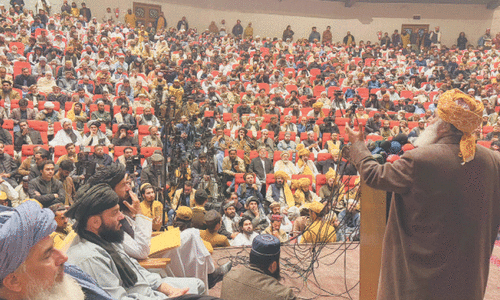
PESHAWAR: A consultative meeting hosted by Khyber Pakhtunkhwa Chief Minister Ali Amin Khan Gandapur here on Saturday emphasised the need for government-level dialogue with Afghanistan to ensure peace in the country.
It also proposed the formation of a jirga of religious and political leaders to facilitate the process.
The meeting, held on the instructions of PTI founder Imran Khan, was attended by leaders of political and religious parties from across the country, according to spokesman for the chief minister Barrister Mohammad Ali Saif in an official statement.
The participants, including leaders of Milli Yakjehti Council Pakistan and United Ulema Board Khyber Pakhtunkhwa, and scholars and other notables from across the country, noted that peace in Pakistan was directly linked to peace in Afghanistan, so Islamabad should initiate immediate negotiations with Kabul for the purpose.
Leaders of political, religious parties attend consultative meeting hosted by CM
They decided that political and religious parties would work together to promote sectarian harmony, as ensuring peace was the most crucial national requirement at the moment.
A declaration was issued after the meeting, with participants denouncing attacks by armed groups on security forces and calling for steps to address unrest in Kurram tribal district.
The call for government-level dialogue with Kabul came at a time when the KP government proposed to send a delegation of tribal elders, religious scholars and political leaders to engage with their Afghan counterparts to address the prolonged conflict and instability in the province’s merged tribal districts.
Sources told Dawn that the government released terms of reference for holding talks with the interim Afghan government using ‘tribal diplomacy’ to address the cross-border concerns.
They said the initiative was meant to utilise tribal diplomacy to discuss mutual concerns, especially regarding peace, security, cross-border trade and economic cooperation.
The sources said that the first phase of talks would begin with a visit of a relatively smaller group to Kabul, including tribal, political and religious leadership along with representatives of the business community and a security official for liaison.
They said that the proposed “foundation-laying visit” was a confidence-building measure, with the objective of encouraging negotiations for peace, mainly to address the cross-border security issues.
The sources said the exercise was also meant to dissuade terrorist organisations from using Afghan territory for attacks in Pakistan, seek cooperation in monitoring and preventing the banned Tehreek-i-Taliban Pakistan and other terror groups’ movements across the border.
They said that the second phase would begin with the main delegation to engage with the Afghan tribal elders and representatives of the Afghan interim government for holding discussion on points covering security, cross border cooperation, trade and issues pertaining to the Afghan refugees living in Pakistan.
The sources said all moves would be made keeping in view Islamabad’s interests. They said that the matter was discussed with the army chief on Jan 14, with CM Ali Amin Gandapur suggesting the use of the jirga, which is already in place in KP.
The sources said that a list of jirga members was being prepared for the first phase.
They said that they expected a stronger coordination among tribes across the border, stronger economic cooperation, reduction of border tensions, and collaborative steps for regional peace and security from the process.
The sources, however, said the provincial government would ensure that the process is aligned with the country’s national, foreign and security policies.
“There won’t be any commitment against the national security framework,” a source said, adding that the provincial government would share the documents with the federal authorities before any step was taken in order to ensure transparency.
When contacted, Barrister Saif, who is the focal person for the exercise, said a mechanism would be developed to ensure safe cross-border movement of people for medical purposes and business, and strengthen cultural and social exchange programmes among communities.
He said that the mechanism would be implemented in two phases.
“We [KP] will formally inform the federal government about the initiative and ensure that the entire process is aligned with security and foreign policies,” he said.
The spokesman also said the provincial government would share a detailed document in that respect with the federal government before engaging with Afghans.
Published in Dawn, February 16th, 2025