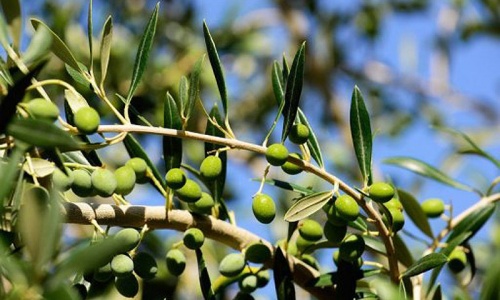
ISLAMABAD: The federal government is exploring olive cultivation on commercial basis in Chagai area of Balochistan under its project to promote olive cultivation in the country.
Besides Chagai area Taftan, Bramcha, Aminabad, Saindek, Chattear areas of Balochistan have enormous potential for olive cultivation with thousands of hectares of land available and suitable and well-adapted promising varieties can be grown in these areas, according to the project director of Olive Cultivation Development Programme.
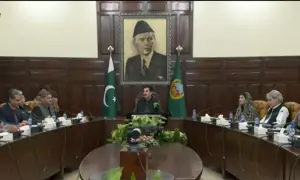
The former Senate Chairman, Senator Sadiq Sanjrani, held a meeting with Minister for National Food Security and Research, Rana Tanveer Hussain, in Islamabad on Wednesday, and discussed measures to promote olive cultivation in Balochistan.
They discussed establishing a research centre of Pakistan Agriculture Research Council (Parc) at Chagai to promote agriculture production in Balochistan.
Taftan, Bramcha, Aminabad, Saindek, Chattear areas of Balochistan have ‘enormous potential for olive cultivation’
During the meeting, matters related to agricultural situation, improvement and transformation of agriculture in the province were also discussed.
Mr Tanveer highlighted the importance of agricultural transformation in a vast area of 40,000 square kilometres of Balochistan and expressed the hope that this area has enormous potential for development of grain and horticultural crops.
Pakistan has a total of 8.2 million hectares of cultivable land, out of which Balochistan has 4.0 million hectares of land.
On the basis of previous plantation, land availability and other climatic variants, the olive development project of the federal government has identified seven potential clusters in the country.
These clusters have been identified in Balochistan. They are Barkhan, Musakhel, Zhob division, Khuzdar, Washuk, Noshki and Panjgoor.
Under the second phase of the olive cultivation programme, commercial olive farming on 75,000 acres of land preferably in the identified clusters will be included in the programme.
An analysis on olive value chain carried out by the International Trade Centre of the United Nations pointed out that commercial plantation of olive crops has been overlooked in Balochistan.
The crop, due to certain characteristics such as low water requirements, drought tolerance, and high resistance against pest and diseases has become increasingly popular in recent times.
In olive plants, hardly any organic or inorganic fertilisers are used in the entire olive growing districts in the North-East and Central parts of Balochistan.
In Balochistan, the department of agriculture research arranged two small units for Khuzdar and two number for Loralai and very recently one number for Musakhel to provide olive processing facilities to farmers at their doorsteps to promote this new crop at production level.
The ITC report says that due to climatic favour, Balochistan olive has oil contents ranging from 18 to 22 per cent while in the Potohar area of Punjab the oil contents are 8 to 10 per cent.
Published in Dawn, February 13th, 2025