ISLAMABAD: The Islamabad High Court (IHC) Chief Justice Aamer Farooq, on Monday, rejected a representation of five judges against changes in judicial seniority, sources revealed.
The decision upheld the revised seniority list following the transfer of judges from three provincial high court and paved the way for the nomination of a recently-transferred Lahore High Court (LHC) judge for the chief justice’s position, which will fall vacant after the elevation of CJ Justice Aamer Farooq to Supreme Court in a couple of days.
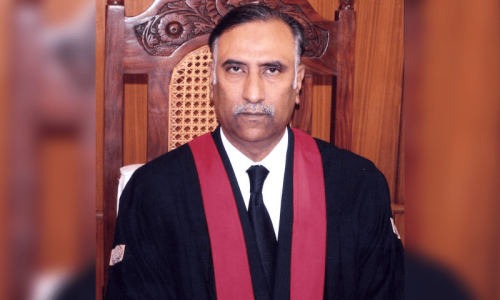
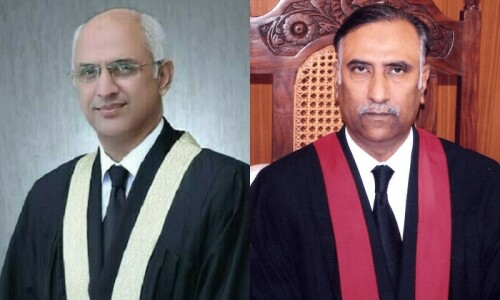
Justice Sardar Mohammad Sarfraz Dogar, who was transferred from the Lahore High Court (LHC) to the IHC, retains his seniority as senior puisne judge in the revised hierarchy.
Justice Dogar had originally taken oath as a high court judge in June 2015. The decision affirms that judges transferred from provincial high courts do not require a new oath, as there is a legal distinction between judicial appointments and transfers.
Decision also paves way for Justice Dogar’s nomination for chief justice’s slot
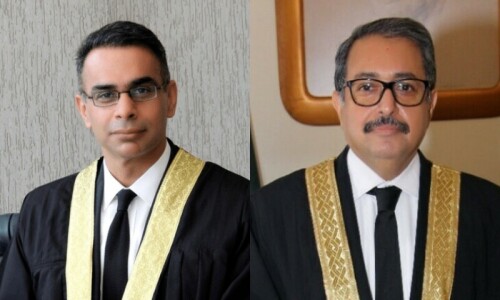
The rejected representations were filed by Justice Mohsin Akhtar Kayani, Justice Tariq Mehmood Jahangiri, Justice Babar Sattar, Justice Sardar Ejaz Ishaq Khan, and Justice Saman Rafat.
The judges contended that under the Constitution, a high court judge must take a new oath upon transfer to a different high court, which should affect their seniority ranking.
However, the decision confirms that seniority will not be reset based on a new oath.
In the representation, the IHC judges approached both chief justices of Pakistan and IHC to reclaim their seniority in the light of changes to the ranking following the transfer of the new judges, particularly Justice Dogar who became the senior puisne judge replacing Justice Mohsin Akhtar Kayani.
Besides losing his coveted position, Justice Kayani was removed from the departmental promotion committee and the administration committee. The judge was also stripped of the position of inspection judge of the special courts.
Before the transfer of Justice Dogar along with Justice Khadim Hussain Soomro of Sindh High Court and Justice Mohammad Asif of Balochistan High Court, five out of 10 IHC judges had penned a strongly worded letter to the president and the CJP besides other high courts’ chief justices, opposing these transfers.
A central concern raised by the judges was that a transferred judge would be required to take a fresh oath under Article 194, which would place them at the bottom of the seniority list within the IHC.
This would render them ineligible for immediate consideration for the CJ’s position, contradicting the JCP Appointment Rules 2024, which mandated that the chief justice of a high court must be appointed from among the three senior-most judges of that court.
According to the representation, submitted by the judges, a judge takes an oath for the high court in which they are appointed. It further emphasised that according to the constitutional intent, a judge must take a fresh oath when transferred to another high court.
Based on this principle, the seniority of a judge transferred to another high court should be determined from the date of their new oath.The judges clarified that their representation strictly concerned the seniority issue and was unrelated to the transfer of judges.
Published in Dawn, February 11th, 2025