Iran’s first drone carrier joins Revolutionary Guards’ fleet

TEHRAN: Iran’s Revolutionary Guards unveiled the country’s first drone carrier on Thursday in Gulf waters, state media reported. The carrier, called the Martyr Bahman Bagheri, is a commercial vessel that was repurposed as a drone carrier over the past two-and-a-half years, Guards naval commander Alireza Tangsiri said during the unveiling ceremony.
Described by Tangsiri as the “largest naval military project” in the history of the Islamic republic, the carrier is capable of launching long-range missiles in addition to carrying drones and helicopters. It is also equipped for electronic warfare, and can remain at sea for up to a year.
Amid military exercises lasting from early January to early March, Iran’s armed forces have unveiled new weaponry as Tehran braces for more tensions with Israel and the United States under President Donald Trump. According to the IRNA state news agency, the vessel has a capacity of 60 drones.
“The Revolutionary Guards took action to transform a commercial ship... into a mobile naval platform capable of carrying out drone and helicopter missions in the oceans,” said Navy Commander of the Revolutionary Guards Alireza Tangsiri. “The addition of this ship to our fleet is an important step in increasing the defence and deterrence capability of Iran in distant waters and in maintaining our national security interests,” Tangsiri added.
During the unveiling ceremony, Guards chief Hossein Salami emphasised that Iran did not seek to threaten others, “but we will not bow to the threat of any power”. He also stated that Iran “will not engage in any wars with the governments we recognise”.
The chief of the Iranian armed forces, General Mohammad Bagheri, who was also present at the ceremony, described the vessel as “a mobile base that can operate self-sufficiently throughout the world’s waters”.
The ship is different from previous Revolutionary Guards warships because it can launch and retrieve larger drones such as the Qaher, a miniaturised drone version of a local fighter jet. The warship also holds fast-attack crafts and unmanned submarines, in addition to short-range anti-ship cruise missiles.
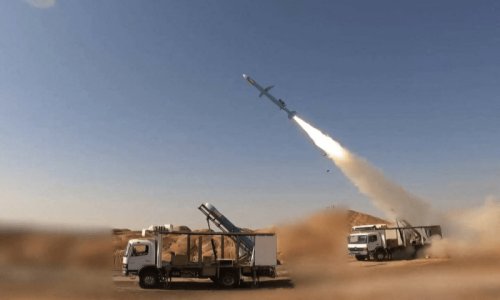
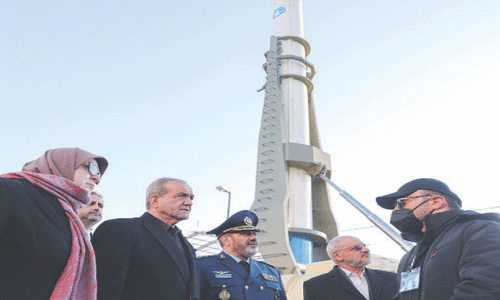
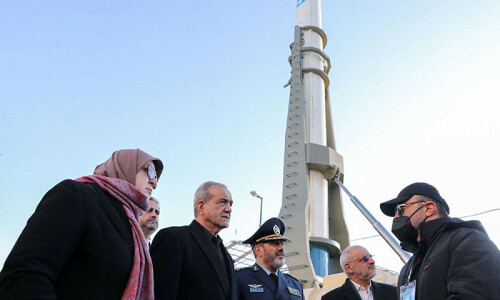
Iran on Sunday unveiled a new ballistic missile it said was capable of reaching targets up to 1,700 kilometres away during a ceremony attended by President Masoud Pezeshkian.
Since the 1979 revolution and the break in ties with the United States — which had been Iran’s main arms supporter — Tehran has developed a series of sophisticated missiles and drones.
The unveiling of the carrier coincides with the so-called Fajr decade, an annual 10-day celebration of the Islamic revolution that overthrew the US-backed shah of Iran. Since the return of US President Donald Trump, who pursued a “maximum pressure” policy against Tehran during his first term, the Iranian government has conducted multiple shows of military strength.
The armed forces have launched large-scale military exercises across the country and showcased underground military bases in recent days.
Published in Dawn, February 7th, 2025