Iran unveils new ballistic missile in show of force

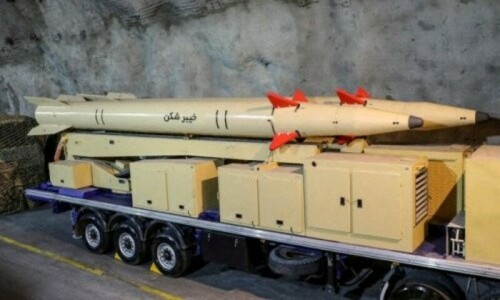
Iran revealed a new ballistic missile on Sunday that it said was capable of travelling 1,700 kilometres, unveiling it at a Tehran ceremony attended by President Masoud Pezeshkian.
State television broadcast images of the missile, dubbed Etemad, or “trust” in Persian, noting its range and calling it “the most recent ballistic missile” built by the Iranian defence ministry.
Western countries have grown concerned over advances in Iran’s ballistic missile programme, accusing it of destabilising the Middle East. Iran’s missiles, including this newest design, are capable of reaching its arch-foe Israel, which it targeted twice last year as the Gaza conflict spilled over.
“The development of defence capabilities and space technologies … aims to ensure that no country dares to attack Iranian territory,” Pezeshkian said in a televised address.
Three domestically produced satellites were also presented at the ceremony: a roughly 34-kilogramme communications model called Navak, as well as updated versions of the Pars-1 and Pars-2.
The latter two are imaging models used to monitor “the environment, emergency situations and urban management”, according to the official IRNA news agency.
The ceremony took place on Iran’s national aerospace day and a few days before the 46th anniversary of the creation of the Islamic republic on February 10, 1979.
Since the return of US President Donald Trump — who pursued a “maximum pressure” approach to Iran in his first term — Tehran has made multiple shows of force, including large-scale military exercises and the presentation of underground military bases.
It also revealed a new model of a cruise missile on Saturday called the Ghadr-380, which a naval commander said had “anti-jamming capabilities” and a range of more than 1,000 kilometres.
At the same time, Tehran has signalled its willingness to restart negotiations over its nuclear programme, which has been the subject of tensions with Western countries for decades.
Iran, which once sourced the majority of its military equipment from its then-ally the United States, has been forced to develop its own weaponry since Washington cut off ties and imposed sanctions in the wake of the 1979 Islamic Revolution.
Having been under an arms embargo during a devastating war with Iraq between 1980 and 1988, Iran now has a substantial arsenal of domestically developed weapons, including missiles, air defence systems and drones.