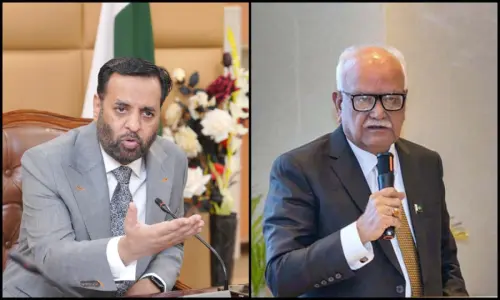
KARACHI: Findings of a recent report have shown that poverty has increased in Pakistan over the years and has left people vulnerable in various ways mainly due to the lack of social security programmes, increasing foreign debts and disproportionate allocations of the gross domestic product (GDP) among other important factors.
The 7th Triennial Poverty and Vulnerability Report, compiled by the South Asia Alliance for Poverty Eradication (SAAPE), was launched by the Pakistan Institute of Labour Education and Research (Piler) at Shaheed Zulfiqar Ali Bhutto Institute of Science and Technology (Szabist) here on Monday.
Abida Ali, core committee member of SAAPE, who also moderated the event, shared some key finding of the report which showed that “Pakistan spends less than 2 per cent of its GDP on social protection, significantly below the global average of 11.2pc. Only 9.2pc of the population is covered by at least one social protection programme, with particularly low coverage for vulnerable groups: children (5.4pc), persons with disabilities (1.7pc) and the elderly (5.8pc).”
Speaking about the report, economist and researcher Dr Asad Sayeed said that poverty has increased in Pakistan during the past five-six years and with very few social protection programmes, people have become vulnerable.
Expert says country’s debt is ‘four times higher than defence budget’
“Our biggest issue is that the country’s debt has significantly increased. Defence expenditure is quite a lot also, which is an issue, but that has been so for decades. Ten years ago, our debt was lesser than the defence expenditure, but now the debt is four times higher than defence budget,” he said.
Compared to other South Asian countries, especially Sri Lanka and India, he said social security in Pakistan is very limited, pointing out issues of macro-management and tax collection as other major reasons behind rising poverty.
“Apart from that, there is institutional weakness in Pakistan, both at the federal and provincial levels,” he said. “There are a few social protection bodies, but they don’t do their work effectively, and therefore, the resources and funds allocated for the poor often get wasted elsewhere.”
Rights activist Mehnaz Rehman focussed on the report’s findings concerning gender disparity in South Asian countries.
Speaking about Pakistan, she said that the social and political system here is patriarchal, which does not treat women equally. As a result, women in the country are poorer and more vulnerable than men.
“In such a society, women’s issues are not a priority. However, women have more burdens and responsibilities than men, yet their work is not even acknowledged as it should be. The worst affected are those who work in the so-called informal sector. There is also a wage gap between men and women, with men being paid more. Women lack ownership of land and other resources. Amid all this, there are no support systems for them, which are desperately needed,” she said.
She also highlighted how a sizable number of women are malnourished and underfed, which in turn leads to the birth of malnourished children.
Dr Riaz Shaikh, dean Faculty of Social Sciences at Szabist, said the report showed that the elite has a control over most resources in the country and its economy due to which they keep become richer while the poor remain poor.
He also pointed out that as compared to other continents, South Asia is the least connected region where the countries do little trade with each other or form economic ties, which, if done properly, will reduce poverty.
“Besides poverty, there is extremism and terrorism. The education sector is also in a bad state. Public sector university teachers are not being paid timely salaries, while retirees are not receiving pensions for months. If all these issues are not addressed, they will lead to a crisis that will be very difficult to resolve,” he added.
Pakistan Peoples Party (PPP) MPA Maleeha Manzoor said that if policies had been followed consistently, the state of affairs would have been better in terms of social protection.
However, she praised the PPP government for always being “pro-people” and noted that Sindh is the only province working more on public welfare programmes compared to others.
Sindh government spokesperson Sukh Dev Hemnani said that the budget allocation for social security should be more than 3pc, as only that could help ensure poverty eradication. He also emphasised the need to restructure debt through climate financing and other climate-related projects.
Published in Dawn, January 28th, 2025