0
0

IN ARABIC, qaseeda means a panegyric ode and ‘burda’ means a shawl-like fabric worn over the shoulders, a mantle. Qaseeda Burda , or Qaseedatul Burda, is a famous poem in Arabic that offers heartfelt expressions of veneration and admiration for Prophet Muhammad PBUH. Composed by Abu Abdullah Sharafuddin Muhammad Ibn-i-Saeed Al-Busiri (1212 - 1296), a Sufi, calligrapher and poet of the Arabic language, Qaseeda Burda is one of the most popular poems of the genre. It has been translated into many languages — including English, German, Latin, Persian, Turkish, Urdu and the Berber language — and over a 100 exegeses have been written.
According to Punjab University’s Urdu Encyclopedia of Islam, the actual title of Qaseeda Burda is Al-Kavaakib-ud-Durriyya Fi Madh-i-Khair-il-Bariyya, or the sparkling stars in praise of the best of creations. It is said Al-Busiri was paralysed and during the ailment he began composing this ode. Once it was completed, he would recite it repeatedly, praying to God for the restoration of health. Once he recited qaseeda and fell asleep while crying and asking God for a cure. Prophet Muhammad PBUH appeared in his dream, patted his afflicted body and put a burda (mantle) over him. When Busiri woke up, he was cured miraculously. Hence, Qaseeda Burda became famous by the name now it is referred to. Qaseeda Burda is very popular among certain circles and is often recited for getting rid of disease or hardships, though Ibn-i-Taymiyya and Muhammad Bin Abdul Wahhaab had shown their displeasure over the practice.
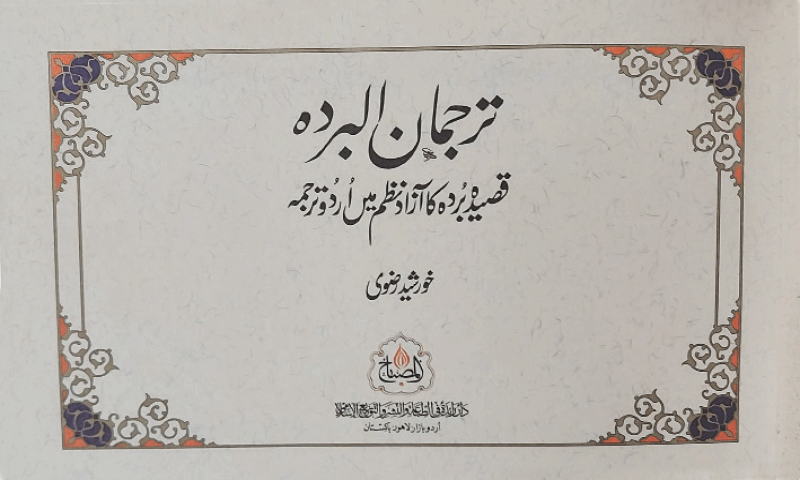
There have been several translations of Qaseeda Burda in Urdu and a new versified translation has been published. Rendered into free Urdu verse by Dr Khursheed Rizvi, it is titled Tarjumaanul Burda and subtitled Qaseed Burda Ka Azad Nazm Mein Urdu Tarjuma. An important feature of this just-published translation is that the corresponding Arabic text is given side by side with the translated Urdu version, making it more attractive for those with a knowledge of the Arabic language. The book’s size is unusual as it is not printed in portrait format but in landscape orientation, perhaps to accommodate the parallel Arabic text.
Translating poetry is not everybody’s cup of tea. It not only requires a mastery over both the languages but also a profound technical acumen and poetic temperament to be able to say it in another language with the same vigour, delicacy and beauty. Then there is another hindrance: sometime some expressions are simply not translatable and saying them in other languages, literally or even metaphorically, may sound unidiomatic or downright ridiculous.
This is one of the reasons why we come across expressions such as ‘lost in translation’ and comments that evoke questions about translation’s faithfulness to the original and its authenticity. Many believe that great works should be read in original. But then, how many languages can one learn to read the masterpieces in original? So translations are inevitable. But poetry’s translation, and that too of a text from a language like Arabic, needs not only the ability but also some poetic creativity and spontaneity, a criterion that only few other than Dr Khursheed Rizvi can fulfill as he is a genuine poet, too. Being an eminent scholar of Arabic, Khursheed Rizvi has taken utmost care in rendering it in Urdu, as shows his intro. And that is why Dr S. M. Zamaan, a renowned scholar of Arabic, has praised Dr Khursheed Rizvi’s Urdu translation of Qaseeda Burda wholeheartedly in his foreword, though at times Rizvi had to differ from the previous translations or exegeses of Qaseed Burda — and for good reasons.
Different versions of Qaseed Burda notwithstanding, the original text had only 162 couplets and rest were added in latter eras. Some believe it originally had 160 couplets, describing different aspects of Islamic teachings, life of Prophet PBUH and ending by asking for God’s forgiveness and supplications. Khursheed Rizvi has translated those 160 couplets whose text is found authentic.
Aside from intricacies of the Arabic language, what has made translating this qaseeda trickier is the fact that Busiri was a calligrapher and he has used several calligraphic terms. In addition, Busiri’s style is highly ornamental, using various terminology used in Arabic syntax and morphology as well as tropes in abundance. That is why Dr Zamaan in his foreword has mentioned that it is for the first time that Qaseeda Burda has ever been translated into Urdu with all its richness of tropes and lexical shades. But the translation is not, as put by Dr Zamaan, pedantic or theological effort of a wordsmith, rather a manifestation of an expert’s poetic temperament and concealed ecstasy.
A very useful portion at the back of the book proffers some explanatory notes, Busiri’s biography and references. The book has some excellent calligraphic images by great Turkish calligrapher Hasan Raza. The elegantly produced book is a collector’s item.
Published in Dawn, January 27th, 2025