• Aurangzeb says economy back on track with inflation down to 5pc
• Finance minister insists privatisation, tax reforms key to economic growth
• Stresses need for self-reliance, moving away from dependency on external aid
TOBA TEK SINGH: Finance Minister Muhammad Aurangzeb said the country’s economy has been put on the right track, with inflation reduced to five per cent, and called on stakeholders to reach a consensus on key economic issues to ensure sustainable stability.
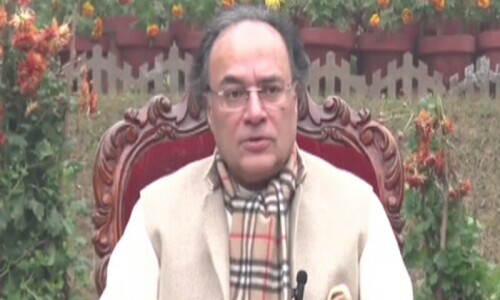
Speaking to reporters at his residence in Judgewala Chak, Kamalia, on Sunday, the minister said that rice exports had increased, and remittances, which stood at $30.2 billion in the last fiscal year, are projected to exceed $35bn in the current fiscal year.
Stressing the importance of self-reliance, he urged moving away from dependency on external aid.
Mr Aurangzeb acknowledged that there are political differences but stressed that everyone should join hands for the vast interest of the country and called for a “charter of economy”.
“We have progressed through our own efforts, not by relying on anyone,” he said, adding that the government aimed to take the national economy towards further improvement in the next year. He also hoped that lower interest rates would help boost economic activity.
“There is no magic wand to fix everything instantly. We need to move towards sustainable economic stability,” he said.
Mr Aurangzeb emphasised the need for policymakers to directly engage with the public and stakeholders. “We will not sit idle in Islamabad. We are visiting cities to seek input from traders and citizens,” he said.
The minister reiterated that Pakistan couldn’t rely on charity to run its economy. While charity can support educational and healthcare institutions, it couldn’t sustain a nation, he added.
He stressed the need to revitalise key sectors, including agriculture, IT, and poultry, identifying agriculture and IT as the twin sectors that drive Pakistan’s sustainable economic growth.
The minister proposed the privatisation of loss-making state-owned enterprises and suggested involving the private sector to manage underperforming institutions.
“Institutions that continue to incur losses should either be shut down or handed over to the private sector,” he said.
Reforms in FBR
The finance minister assured taxpayers of reforms in the Federal Board of Revenue, promising no additional burden on salaried individuals.
He noted that the government is working to increase the country’s tax-to-GDP ratio from 9-10pc to 13.5pc, with plans to simplify the taxation regime, digitise processes and minimise human intervention.
Mr Aurangzeb also noted that research institutions had failed to achieve the desired results in agriculture, attributing the inefficiency to the allocation of 80pc of their budgets towards salaries, leaving only 20pc for research.
He also mentioned the increase in consumption of cement and fertiliser, as well as a 58pc surge in auto sales, as indicators of the government’s prudent policies.
On energy, he announced plans to further reduce tariffs and improve the performance of the power distribution companies.
He also assured farmers of access to agricultural loans to enhance productivity.
Mr Aurangzeb reiterated the need for privatisation in critical sectors to stimulate growth and reduce the financial burden on the government.
He proposed shutting down the Pakistan Agricultural Storage and Services Corporation and replacing it with a private-sector mechanism for maintaining strategic reserves.
The minister also highlighted Sialkot as a model of self-sufficiency and Kamalia Khaddar as a global brand, urging stakeholders to learn from these examples to drive economic progress.
Mr Aurangzeb’s uncle and former federal minister, Chaudhry Asadur Rehman Ramday, and former Punjab advocate general Mustafa Ramday were also present on the occasion.
Published in Dawn, December 30th, 2024