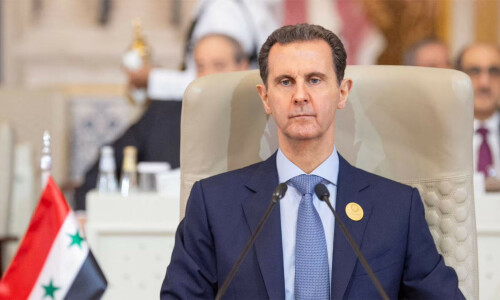
Syrian leader vows to bring all arms ‘under state control’


DAMASCUS: Two weeks after seizing power in a sweeping offensive, Syria’s new leader Ahmed al-Sharaa — also known as Abu Mohammed al-Jolani — on Sunday said weapons in the country, including those held by Kurdish-led forces, would come under state control.
He was speaking alongside Turkish Foreign Minister Hakan Fidan, after earlier meeting with Lebanese Druze leaders, where he vowed to end “negative interference” in neighbouring Lebanon.
During a press conference with Fidan, Sharaa said Syria’s armed “factions will begin to announce their dissolution and enter” the army.
“We will absolutely not allow there to be weapons in the country outside state control, whether from the revolutionary factions or the factions present in the SDF area”, he added, referring to the Kurdish-led Syrian Democratic Forces.
Says his regime working on protecting sects and minorities; vows to end all interference in Lebanon
Ankara-backed rebels played a key role in supporting Sharaa’s Islamist group Hayat Tahrir al-Sham (HTS), which headed a rebel alliance and seized Damascus on December 8 Sharaa — also known as Abu Mohammed al-Jolani — had traded in the olive-green military shirt he sported just days ago for a suit and tie during his meetings Sunday at the presidential palace.
He also said “we are working on protecting sects and minorities from any attacks that occur between them” and from “external” actors exploiting the situation “to cause sectarian discord”.
“Syria is a country for all and we can coexist together,” he added.
Fidan said sanctions on Syria must “be lifted as soon as possible”. He called for the international community to “mobilise to help Syria get back on its feet and for the displaced people to return”.
Turkiye has maintained strong ties with Syria’s new leaders, and Ankara’s intelligence chief Ibrahim Kalin was in Damascus just four days after Assad fell.
Ankara has meanwhile continued operations against Kurdish-held areas in northeastern Syria, with a Britain-based war monitor reporting on Saturday that a Turkish drone strike killed five civilians in the area.
Ankara regards the People’s Protection Units (YPG), the main component of the SDF, as being linked to the militant Kurdistan Workers’ Party (PKK) at home, which both Turkiye and Western allies deem a “terrorist” organisation.
Regional powerhouse Saudi Arabia is also in direct contact with Syria’s new authorities, having supported the opposition to Assad for years during Syria’s civil war. Riyadh will send a delegation to the country soon, Syria’s ambassador in the Saudi capital said.
During his meeting with visiting Lebanese Druze chiefs Walid and Taymur Jumblatt, Sharaa said Syria will no longer exert “negative interference in Lebanon at all”.
The seizure of power by the Sunni Islamists of HTS — proscribed as a terrorist organisation by many governments including the United States — has sparked concern, though the group has in recent years sought to moderate its rhetoric.
Despite worries over Syria’s future, global powers including the United States and the European Union have stepped up contacts with the war-ravaged country’s new leaders, urging them to guarantee protections for women and minorities.
The supreme leader of Iran — a major backer of Assad’s administration before it fell — on Sunday predicted “the emergence of a strong, honourable group” that would stand against “insecurity” in Syria.
Ayatollah Ali Khamenei said Syria’s young men would “stand with strength and determination against those who have designed this insecurity and those who have implemented it, and God willing, he will overcome them”.
Published in Dawn, December 23rd, 2024