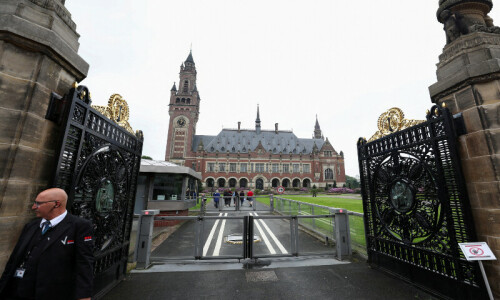
THE HAGUE: The future of the planet is at stake during hearings at the top United Nations court, a representative for Vanuatu said on Monday, opening a historic case that aims to set a legal framework on how countries should tackle climate change.
More than 100 countries and organisations are set to present before the International Court of Justice over the next two weeks, the highest number ever.
“The outcome of these proceedings will reverberate across generations, determining the fate of nations like mine and the future of our planet,” said Vanuatu’s representative for climate change, Ralph Regenvanu. “This may well be the most consequential case in the history of humanity,” Regenvanu told the 15-judge bench in the panelled hall of the Peace Palace in The Hague.
Activists hope the ICJ opinion will have far-reaching legal consequences in the fight against climate change, impacting ongoing court cases as well as domestic and international legislation. Others fear the UN-backed request for a non-binding advisory opinion will have limited impact — and it could take the UN’s highest court months, or even years, to deliver.
A handful of protesters gathered outside the Peace Palace, near a big screen reading “We are watching”. Demonstrators had hung banners saying: “Biggest problem to the highest court” and “Fund our future, climate finance now.” “This hearing means everything for the climate justice movement,” Siosiua Veikune, 25, from Tonga, who is part of the Pacific Island Students Fighting Climate Change group, said.
The presentations at the scenic Peace Palace come days after a bitterly negotiated climate deal at the COP29 summit in Azerbaijan. The UN General Assembly adopted a resolution last year that referred two key climate questions to the ICJ.
First, it asked, what obligations do states have under international law to protect the Earth’s climate system from polluting greenhouse gas emissions?
Second, what are the legal consequences of these obligations in cases where states, “by their acts and omissions, have caused significant harm to the climate system and other parts of the environment”.
Record-high emissions
Joie Chowdhury, a senior lawyer at the US- and Swiss-based Centre for International Environmental Law, said climate advocates did not expect the ICJ’s opinion “to provide very specific answers”.
Instead, she predicted the court would provide “a legal blueprint … on which more specific questions can be decided”.
The judges’ opinion, which she expects some time next year, “will inform climate litigation on domestic, national and international levels”. Some of the world’s largest carbon polluters — including the top three greenhouse gas emitters, China, the United States and India — will be among the 98 countries and 12 organisations to address the court.
The world agreed in Paris in 2015 to try to limit global heating to 1.5 degrees Celsius (2.7 degrees Fahrenheit) above pre-industrial levels. But it did not prescribe how to achieve that and it is nowhere near on track.
Published in Dawn, December 3rd, 2024