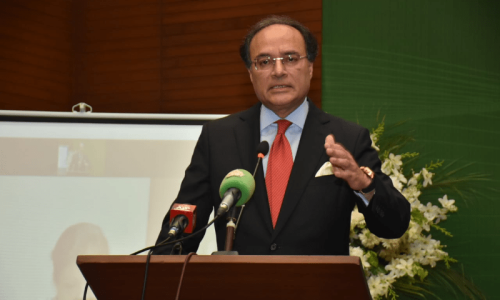
SPEAKING to an audience in Riyadh earlier this year, Finance Minister Muhammad Aurangzeb labelled the undocumented economy Pakistan’s “biggest challenge”. Given his role, and the associated IMF-coloured pressures that come with it, his understanding of the challenge is concerned primarily with the narrow tax base and the lack of taxes collected in the country.
Each Pakistani government over the past three decades has voiced a similar concern, even if it’s been phrased differently. In the past, this problem was sidestepped and bypassed through loans and support from foreign countries. With support less forthcoming and the IMF being a little less forgiving, the tax challenge is proving to be far more consequential.
Efforts to make the tax system fairer, and to make the proverbial big fish in sectors such as agriculture and retail-wholesale trade pay up, are long overdue. At the same time this recent attention towards the undocumented or informal economy provides a chance to develop an improved understanding of how many Pakistanis actually go about eking out a living (and a how a few make a lot).
To paraphrase Castells and Portes’s definition, the informal economy is ‘all income-generating activity that is unregulated in a context where similar activities are regulated’. The first thing apparent from this definition is that much of the informal or undocumented economy is different from the ‘illicit economy’, ie, it does not consist of trade and production of goods and services that are deemed illegal.
The informal economy deserves far more attention in any analysis of Pakistan’s societal functioning and stability.
Most of what gets made and traded in the informal economy is licit, but some part of the process through which it is made and/or traded is not according to existing laws and policies. To give an example, a registered importer bringing in fully taxed consumer goods will be part of the formal economy, while a businessman bringing in the same goods via misdeclaration that involves bribes to custom officials, or smuggling through a land border, will be part of the informal economy.
To give an example from the manufacturing sector, there is no law forbidding the production of soap. But the soap made by a registered factory, paying taxes and meeting environmental, social, and labour regulations, is part of the formal economy; while soap being made in a small unregistered workshop by a proprietor and their own family labour would be considered part of the informal economy.
Broadening our perspective on what the undocumented economy actually is allows several facts to emerge. First, there is a great deal of variation within the informal sector. It includes everything from smuggled tyres and cigarettes that are traded from Karachi to Khyber, to homemade soap sold only within a village or a small community. When we talk about the taxation challenges of the undocumented sector, it is important to be aware of what type of activity is worth going after.
Secondly, informality operates on a spectrum. It is possible that some aspect of any activity may be registered or regulated. A sales tax-evading shop will likely be registered with the local Disco or it may even be filing tax returns but misreporting its actual sales and income. Similarly, a lot of smuggling takes place via trade by registered entities through formal channels like the seaports in Karachi, but laced with misdeclaration and evasion.
Third, and closely related to the previous point, is the integral role of the state in actually sustaining the undocumented economy. Any person who has worked in large wholesale markets in big urban centres, or seen the nature of trade in border districts can tell you that most informal trade happens under observation of, and with approval from, state officials, especially those tasked with border security. Their reasons for allowing it might include personal gain through bribery, but also perhaps a need to maintain social peace and sustain livelihoods necessary in remote localities.
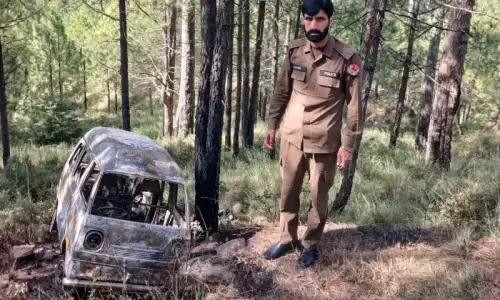
In an op-ed last week, my teacher Aasim Sajjad Akhtar pointed out how militant activity currently wreaking havoc in two provinces is at least partly sustained by smuggling along borders otherwise manned by the state. Seen in this vein, some part of the undocumented economy challenge speaks not just to the basic arithmetic of government budgets, but of the very ability of the state to enforce rules on its own personnel, maintain territorial sovereignty, and ensure peace.
Fourth, and perhaps most crucially, the informal economy deserves far more attention in any analysis of Pakistan’s societal functioning and stability. It is frequently speculated, with good reason, that pervasive undocumented economic activity may be the safety net that sustains livelihoods for millions of households in an otherwise faltering economy.
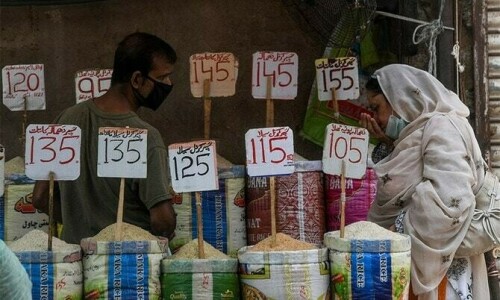
When people wonder why the crushing inflation of the past three years didn’t bring people out on the streets in spontaneous rage, part of the answer could be that the undocumented economy — small-scale trading, petty production, charitable acts, and even gift-giving among families and kin groups — is what allows basic subsistence and consumption to continue.
This is not to suggest that somehow Pakistan enjoys widespread off-the-books prosperity. Such wealth is probably only true for a small number who are accumulating large profits by undocumented means. But rather when government decision-makers talk about the challenges of the undocumented economy, two things should be kept in mind: the state is intimately involved in perpetuating informality and sustaining undocumented wealth accumulation. Therefore, the challenge of the undocumented economy is actually a challenge for the state to fix itself.
And secondly, the undocumented economy comprises immense internal diversity and sustains households who are otherwise ignored and excluded by the formal sector. Steps for documentation need to be thought through carefully to guard against harmful consequences for those who have no other option.
The writer teaches sociology at Lums.
X: @umairjav
Published in Dawn, November 25th, 2024