‘Cut the theatrics’: UN climate chief at deadlocked COP29


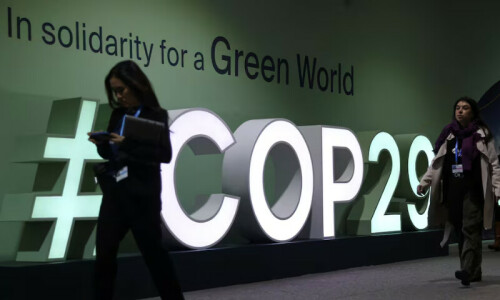
The UN’s climate chief told countries at the deadlocked COP29 summit on Monday to “cut the theatrics” as pressure mounts on G20 leaders to deliver a breakthrough.
As the UN climate talks limp into a second week in Azerbaijan, the world is no closer to a finance deal for poorer countries that will determine the success or failure of COP29.
UN climate boss Simon Stiell said that “bluffing, brinkmanship and premeditated playbooks burn up precious time and run down the goodwill needed”.
“Let’s cut the theatrics and get down to business,” he told delegates assembled in a cavernous football stadium in Baku.
Nations have until Friday to break the impasse over how to raise $1 trillion a year for developing countries to cope with global warming.
Pressure is mounting on G20 leaders to throw their weight behind the stalled process in Baku as they meet in Brazil for the annual summit of the world’s biggest economies — and top polluters — on Monday and Tuesday.
“A successful outcome at COP29 is still within reach, but it will require leadership and compromise, namely from the G20 countries,” UN Secretary-General Antonio Guterres said on Sunday in Rio de Janeiro.
COP29 president Mukhtar Babayev of Azerbaijan said it was a crucial moment for G20 countries “to show their leadership”.
“We cannot succeed without them, and the world is waiting to hear from them,” the former oil executive turned ecology minister told reporters.
In a sign that a solution could emerge from Rio, the head of the Brazilian delegation to COP29, Andre Aranha Correa do Lago, left Baku to prepare for the G20.
Life or death
A fight is also brewing at COP29 over whether countries should recommit to last year’s landmark pledge to move the world away from fossil fuels.
Saudi Arabia has been accused of obstructing efforts to address this and other measures to reduce record-high emissions of planet-heating greenhouse gases.
The main task at COP29 is negotiating a new deal to provide developing countries with enough money to cut emissions and build resilience against worsening climate shocks.
Rei Josiah Echano, disaster chief in the typhoon-hit Philippines province of Northern Samar, called for talks to be “radically fast-tracked” to help those in dire need.
Developing countries, excluding China, will need $1tr a year in outside assistance by the end of the decade, according to independent economists commissioned by the United Nations.
Stiell said it was “easy to become slightly anaesthetised” by the numbers.
“But let’s never allow ourselves to forget: these figures are the difference between safety and life-wrecking disasters for billions of people,” he said.
“It certainly keeps me up at night.”
Hosts criticised
Climate-vulnerable countries want developed nations to commit to substantially raising their existing pledge of $100 billion a year.
But donors say they cannot raise the money alone and the private sector must also be involved.
The United States and European Union also want wealthy emerging economies not obligated to contribute to climate financing — most notably China — to share the burden.
“With affluence comes responsibility. Others have a responsibility to contribute based on their emissions and based on their economic growth,” EU climate commissioner Wopke Hoekstra told reporters in Baku.
The EU is the biggest contributor to international climate finance and would “continue to lead”, Hoekstra added.
But the 27-nation bloc faces political and budget pressure, and could be left exposed should the United States refuse to pay up under Donald Trump.
The conference opened in the shadow of Trump’s re-election and took a knock when Argentina’s delegation withdrew from the summit.
Azerbaijan lacks global diplomatic experience at a time when COP observers say crucial leadership is needed to steer the difficult negotiations.
“We do need a presidency to lead and to steer us in the direction of a safe landing ground,” Hoekstra said.
Azerbaijan’s president, Ilham Aliyev, drew criticism for defending fossil fuels and attacking France over its colonial record.
In a letter to Aliyev on Monday, the EU’s top human rights body called for political prisoners in Azerbaijan to be released.