At COP29, every day is a ‘leg day’, at least for journalists, who have to run from one block to another, trying to keep up with the various sessions going on simultaneously, all the while trying to get hold of their respective countries’ delegations.
The negotiations, on the other hand, are going nowhere, as the developed and developing worlds bicker over the new climate finance goal, aka the New Collective Quantified Goal.
COP29 was off to a bumpy start since the very first day, and the little headway that has been made is on standards to boost the global carbon market under Article 6.4 of the historic Paris Agreement signed in 2015.
Some of the countries were unhappy with how these guidelines were rushed through without any debate, which may pose a problem at a later stage.
There is, however, little progress on what the carbon markets will look like and how countries will evolve a consensus on carbon credits, which supposedly provide solutions to climate problems.
Controversial carbon markets, non-operationalisation of Loss and Damage fund among key sticking points
By the evening, after a delay of several hours, parties managed to agree in principle on a draft for the new finance goal, but it will be a long time before any final agreement is reached.
Supposedly, the money earned from carbon markets will be part of climate finance — a contentious issue between the North and South — as even after over a decade, its modalities still need to be hammered out.
Interestingly, some Latin American countries such as Venezuela and Ecuador who had opposed such schemes at every climate conference, seemingly gave in this time.
Activists and civil society members at COP29 see these credits as ‘false solutions’, which are not acceptable to them.
Whither loss and damage?
Let’s set aside this controversial topic for a minute. Even the Loss and Damage (L&D) Fund — which was operationalised at COP28 in Dubai — has not picked up steam.
Out of over $700 million in pledges made at the last COP, only $10 million materialised which came from Japan, according to the Loss and Damage Collaboration.
The fund was established at COP27 after 31 years of “inaction, delay and obfuscation by developed country parties since the first proposal for a Loss and Damage finance mechanism was tabled by Vanuatu on behalf of the Alliance of Small Island States (AOSIS) in 1991”.
At present, the fund is empty.
The World Bank, which maintains the secretariat of this fund, says it has no control over the money supposed to be contributed to the account.
Arif Goheer, executive director of the Global Change Impact Study Centre, told Dawn at the Pakistan Pavilion there were losses to the tune of trillions, and the L&D Fund was not equipped to deal with that.
“Loss and Damage does not have even procedures,” Mr Goheer, who is privy to negotiations, said, adding that the fund should be topped up with ample amount of money keeping in view of vulnerabilities of different, especially the most-affected states with no coping capacities.
According to Mr Goheer, since the L&D Fund is for emergencies and natural disasters, it should be given instantly to help the countries cope with it instead of linking it to the project-based funding.
About the negotiations, he said G-77 and China block, which also includes Pakistan, want easy to climate funds as well as easy procedures for accessing them. The talks to agree on a climate finance goal will continue on Saturday, the official added.
Global Stocktake
Similarly, in the first week of COP29, the countries have failed to take the Global Stocktake, which could potentially delay the new NDCs (Nationally Determined Contributions) which all parties are expected to submit by February 2025.
The global stocktake takes a look at the performance of countries with regard to their NDCs as well as set the stage for the more ambitious ones.
The Adaptation Fund has also hit a stonewall due to significant disagreements between developed and developing countries on adaptation-related matters, particularly the provision of Means of Implementation (MOI).
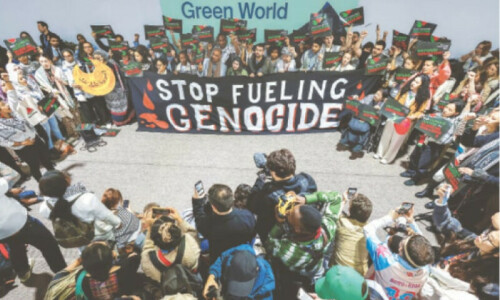
Concerns have been expressed by activist groups at COP29, who believe the presence of fossil fuel lobbyists at the venue is counterproductive as they step up their campaign ‘Weed Out the Snakes’ and ‘Let’s Kick Big Polluters Out’.
According to Rachel Ross, there are almost 1,700 fossil fuel lobbyists at the venue who are “poisoning” climate action.
On the third day of COP29, the Argentine delegation was abruptly pulled out of the conference on the orders of its president, who is a climate denier.
Its neighbour, COP30 host Brazil, has submitted its NDCs and is poised to host the next conference, which is evident from the massive pavilion in Baku.
On Monday, the conference enters its second phase with ministers from different countries coming together to hammer out an agreement acceptable to all.
Produced as part of the 2024 Climate Change Media Partnership, a journalism fellowship organised by Internews’ Earth Journalism Network and the Stanley Centre for Peace and Security.
Published in Dawn, November 16th, 2024