Rice production faces sustainability challenges


ISLAMABAD: While rice cultivation area has increased by 29 per cent over the last 10 years, expanding production faces sustainability challenges, primarily due to its significant environmental impacts, particularly concerning carbon emissions and water usage, reveals a report by the Asian Development Bank (ADB).
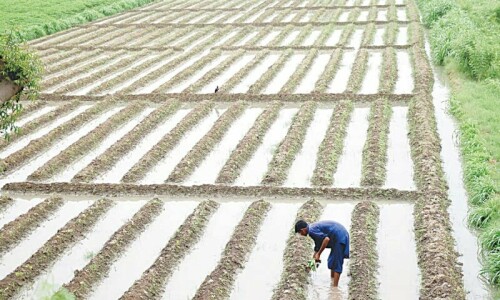
The report, “Transitioning to Low-Carbon, Resilient Rice Production in Pakistan”, published in ‘Development Asia’ says the traditional practice of continuously flooding rice paddies creates a low-oxygen environment in soil, leading to substantial methane emissions — a potent GHG that accelerates climate change. This irrigation method also results in high evaporative water losses, making rice cultivation the largest consumer of freshwater in Pakistan.
ADB supports Pakistan’s adoption of alternate wetting and drying–a transformative approach to promote sustainable rice practices. Unlike the current practice of continuous flooding, alternate wetting and drying is a water management method that involves periodically drying rice fields for a few days between periods of flooding.
This process has been proven to reduce water use in intensive rice systems by 30 per cent and GHG emissions from 30pc and 70pc. However, the potential of alternate wetting and drying to save water and reduce GHG emissions has yet to be investigated in Pakistan.
Pakistan urged to adopt alternate wetting and drying irrigation method
Data from the first year of the pilot study — investigating the benefits of alternate wetting and drying in reducing GHG emissions and improving water productivity — collected from Punjab’s Sheikhupura and Okara districts are currently being analysed to show the initial effects of this method on rice production.
The study is the first in Pakistan to estimate GHG emissions from rice systems, aiming to develop country-specific emission factors for rice cultivation using the Intergovernmental Panel on Climate Change-recognised scientific methods. This will enhance the accuracy of the country’s GHG inventory and provide essential data for carbon market initiatives.
The study will also identify and address barriers preventing rice growers from adopting alternate wetting and drying and propose effective strategies to encourage its widespread adoption in Punjab’s rice cultivation.
The trials will generate relevant data to establish robust evidence on the benefits of alternate wetting and drying to increase water productivity and profitability of rice production in Pakistan’s specific environment.
In addition, the trials will serve as a platform for building the capacity of researchers and agricultural agencies, equipping them with the knowledge and skills to implement, monitor, and report on alternate wetting and drying practices and GHG emissions at the national level.
According to the report, rice is the largest consumer of irrigation water used in the country while contributing only one per cent to its GDP. Although recent reforms in Punjab shifted water pricing mechanisms to crop-specific rates from flat per acre to promote crop diversification, the changes were ineffective.
Low water prices failed to incentivise the adoption of water-saving technologies. Small landholdings without on-farm water storage systems further undermine efforts to improve water use efficiency, as farmers cannot store excess water for future use.
With the increase in production, rice exports surged by 95 per cent over the last decade, making it the country’s second-largest export, contributing $3.7 billion to the national foreign exchange reserves. The province of Punjab accounts for 69 per cent of total rice production.
Despite these gains, expanding rice production comes with sustainability challenges due to its high environmental impact, particularly in terms of carbon emissions and water usage.
Rice is the largest consumer of irrigation water used in the country while contributing only one per cent to its GDP. Although recent reforms in Punjab shifted water pricing mechanisms to crop-specific rates from a flat rate per acre to promote crop diversification, the changes were ineffective.
Low water prices failed to incentivize the adoption of water-saving technologies. Small landholdings without on-farm water storage systems further undermine efforts to improve water use efficiency, as farmers cannot store excess water for future use.
Published in Dawn, November 17th, 2024